Roy Barton was my uncle. Although he died in 2001, it was only following the death of his reclusive son that Roy’s 250 letters written during World War Two to his wife Phyllis have come to light (over 110,000 words).
It is not just his letters either. Roy kept a scrapbook of photos and memorabilia from his family and service life that add detail and great interest to the story he tells in the letters.
Roy had been married for just three years when the Second World War started. The first 25 letters detail his Basic Training in Yorkshire. The rest (over 220) constitute a wartime diary of one man’s war over 400 days, written from the relative safety of Field Marshal Montgomery’s HQ in Normandy, Belgium and into Germany.
Roy was a civilised and emotionally intelligent natural-born writer educated at public school. He describes in detail the demands of each day, whether in Basic Training or in Northern Europe; the destruction of German armour at Falaise, the French peasant farmers, Belgian black marketeers, leave in Paris and Brussels, the characters and gossip from his mess, the stresses of war and its effects on him, as well as their hopes for a ‘cottage in the country’ and plans for a baby at the war’s end.
Through it all Roy nevertheless finds many ways to express his love and give Phyllis the sweet anticipation of the letterbox rattle.
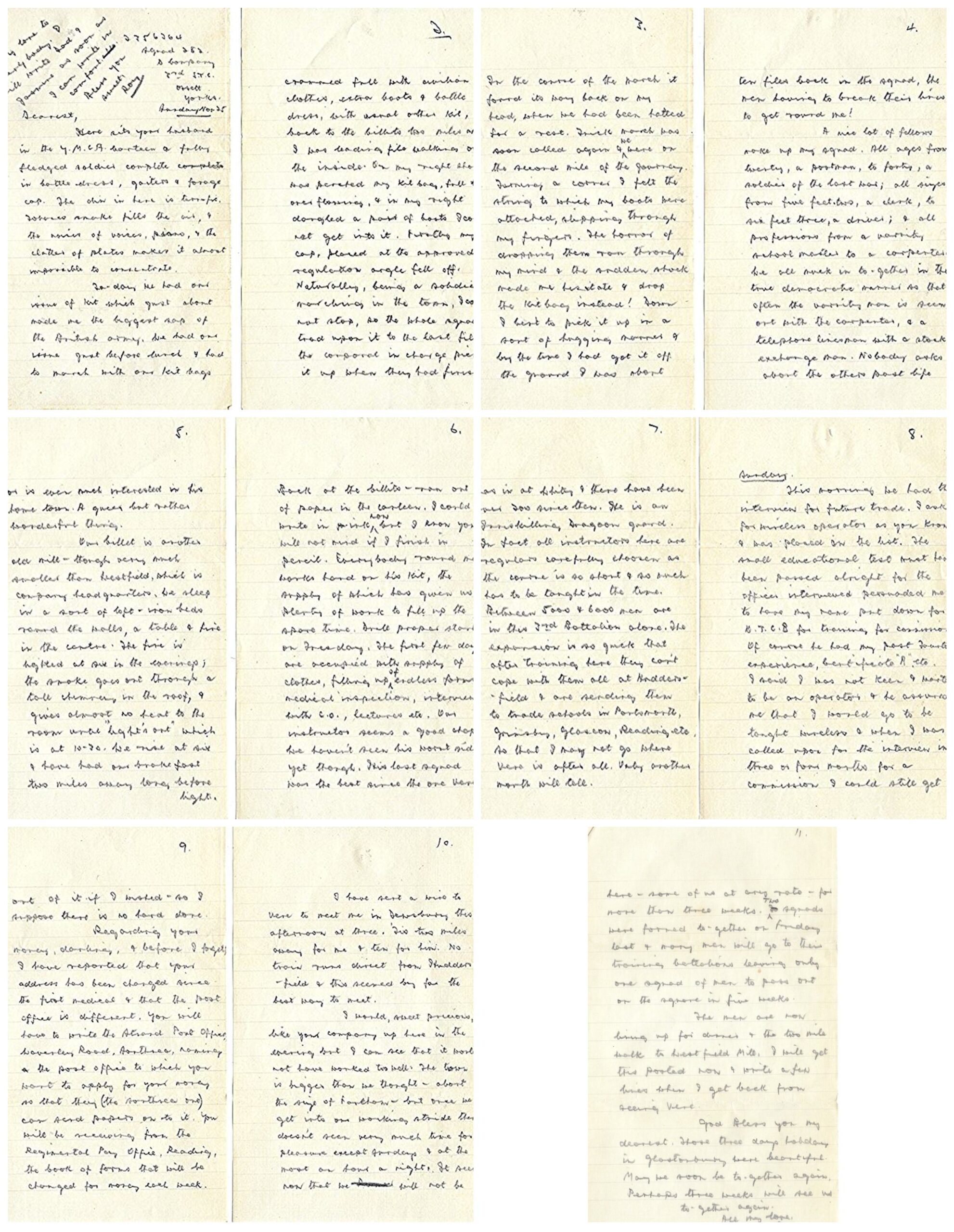
Much devoted to his young wife and with little in the way of other evening entertainment or distractions, Roy wrote letters almost daily to Phyl detailing the events of his days of Basic Training. Here is the first of Roy’s letters, written from his Basic Training Camp in Yorkshire.
Then, in August 1944 Roy lands with Field Marshall Montgomery’s HQ in Normandy. Roy was the Quartermaster Sergeant in the GHQ Liaison Regiment known as ‘Phantom’ attached to Montgomery’s HQ Main of 21st Army Group. Over the next 430 days until October 1945, Roy writes to Phyl over 200 letters as he travels through Normandy, Belgium, Holland and into Germany.
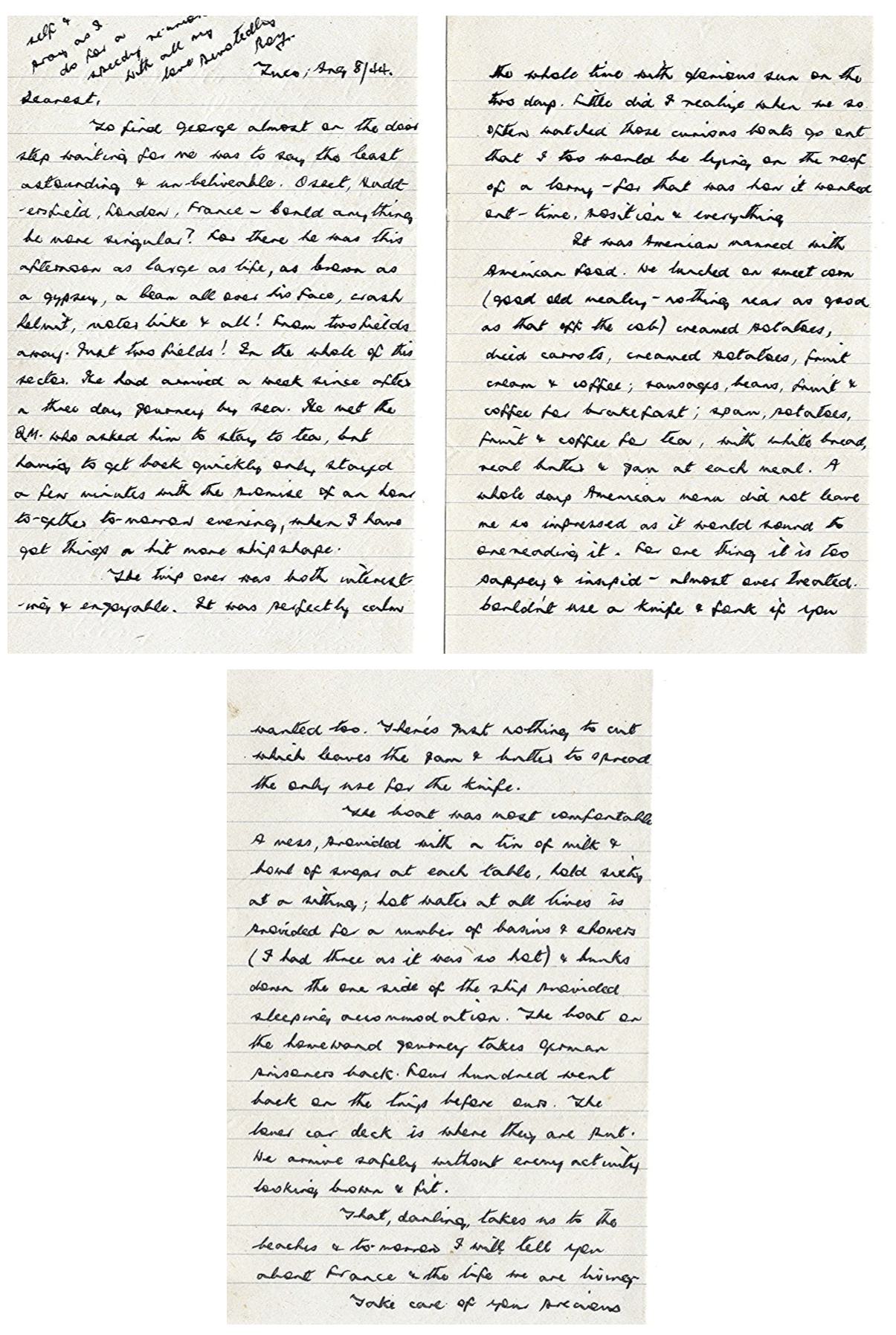
In this letter, Roy describes his arrival in Normandy on 7th August 1944 attached to Royal Signals ‘Phantom’ Regiment of Montgomery’s 21st Army Group HQ (Main).
Extraordinarily, his brother George is camped close by and comes to greet him having landed some weeks previously. Roy’s attention to detail is extraordinary in the midst of war as he describes the ferry, the ship’s US processed food, the weather, etc. One can feel the exuberance of the wartime spirit in his writings:
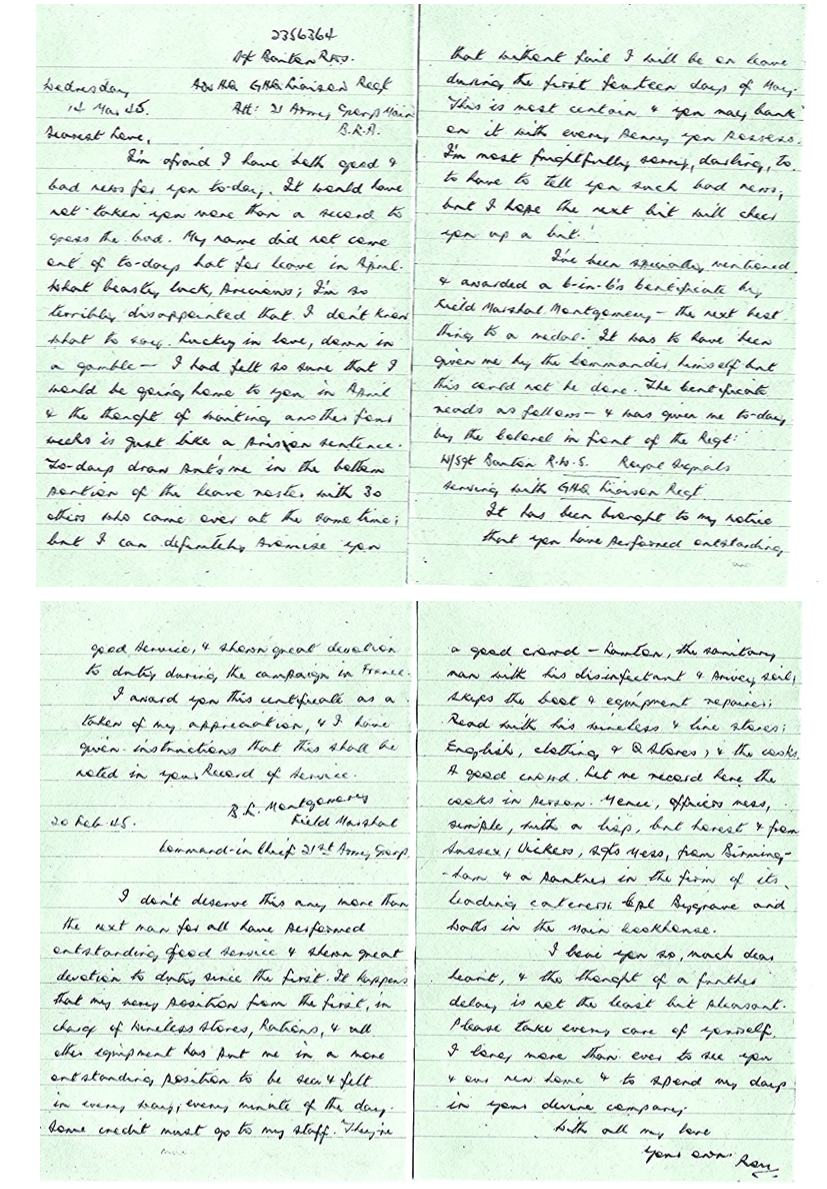
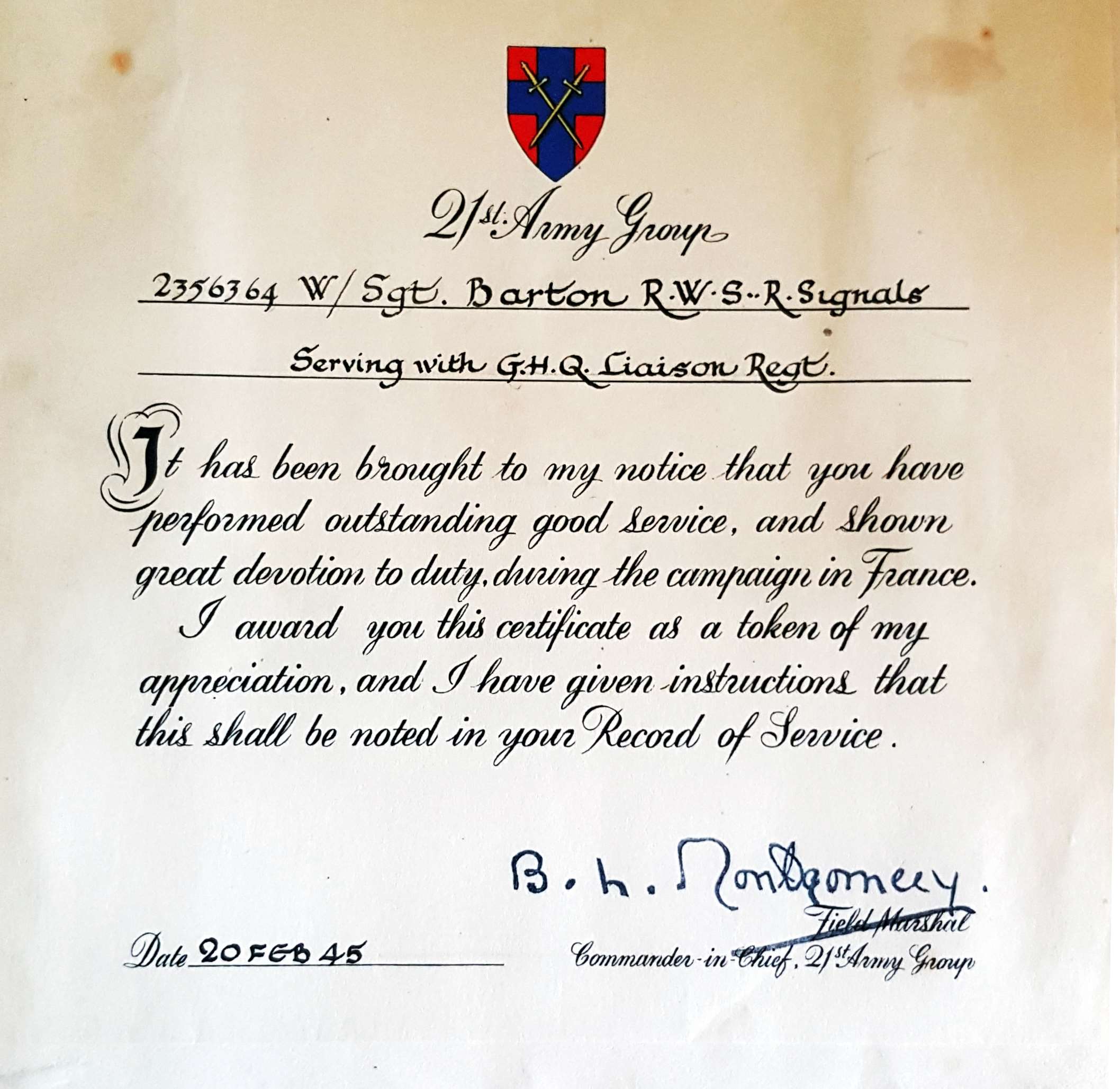
In this letter Roy gives Phyl the bad news about no UK leave yet. But also that he has been awarded a Commander in Chief’s Certificate for ‘Outstanding good service’ by Field Marshal Montgomery. Typical of self-effacing Roy, he wants to praise his own staff for their contribution to his own award:
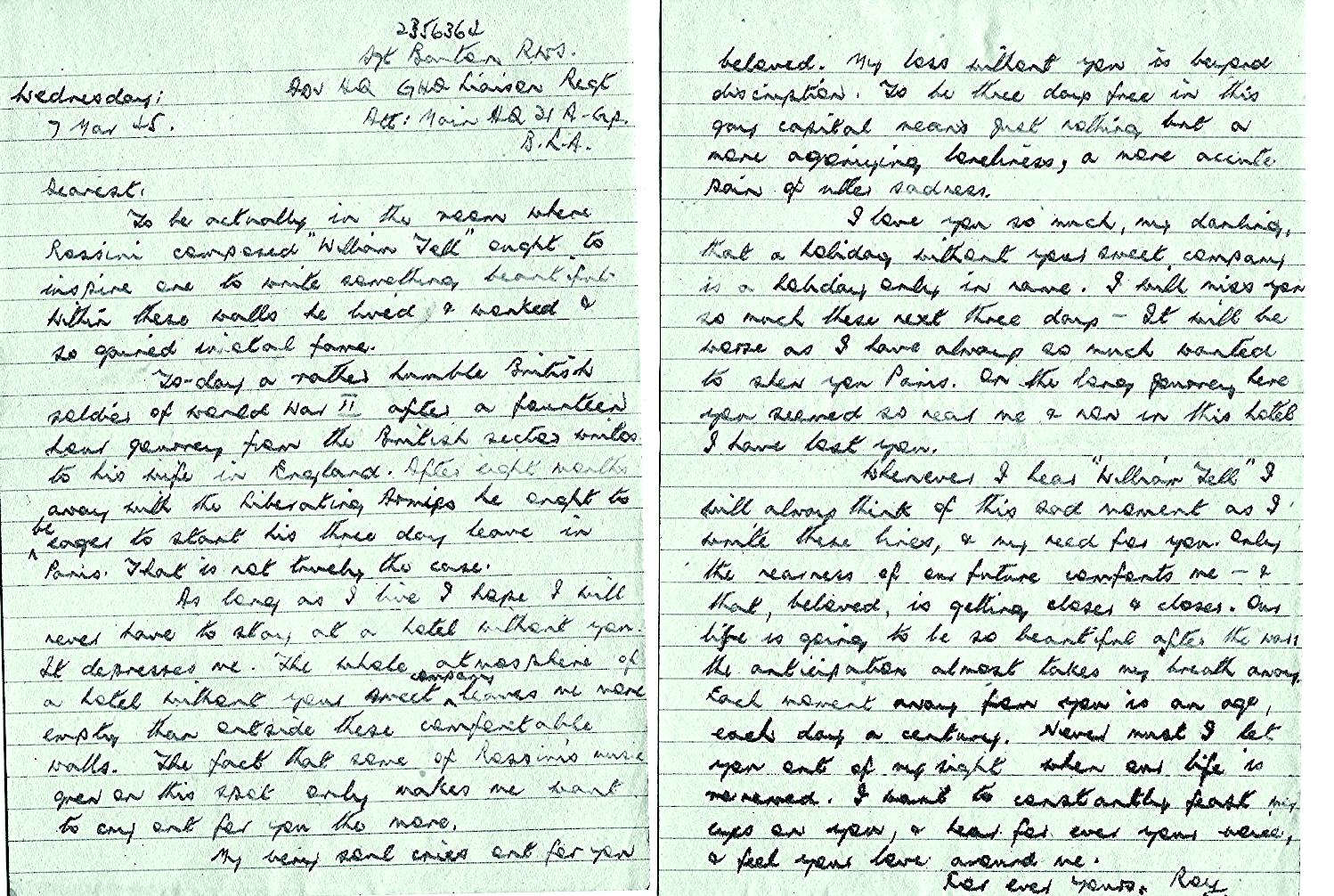
This love letter is sent from Paris where Roy is enjoying three days of leave after an exhausting winter of activity following the Ardennes offensive by the Germans. He is in the “room where Rossini composed ‘Willian Tell'”, but the ache of missing his wife almost overwhelms him. “As long as I live, I hope I will never have to stay in a hotel without you.” Beautifully expressed passion for his wife, Phyllis.
Transcript:
Letter 1:
2356364
Dearest,
Here sits your husband in the Y.M.C.A. canteen a fully fledged soldier complete in battle dress, gaiters & forage cap. The din in here is terrific. Tobacco smoke fills the air, & the noise of voices, piano, & the clatter of plates makes it almost impossible to concentrate.
To-day, we had our issue of kit which just about made me the biggest sap of the British army. We had one issue just before lunch & had to march with our kit bags crammed full with civilian clothes, extra boots & battle dress, with usual other kit, back to the billets two miles away. I was leading file walking on the inside. On my right shoulder was perched my kit bag, full & overflowing, & in my right dangled a pair of boots I could not get into it. Further my cap, placed at the approved regulation angle fell off. Naturally, being a soldier marching in the town, I could not stop, so the whole squad trod upon it to the last file. The corporal in charge picked it up when they had finished.
In the centre of the march it found its way back on my head, when we had been halted for a rest. Drill march was soon called again & we were on the second mile of the journey. Turning a corner I felt the string to which my boots were attached, slipping through my fingers. The horror of dropping them ran through my mind & the sudden shock made me hesitate & drop the kit bag instead! Down I bent to pick it up in a sort of hugging manner & by the time I had got it off the ground I was about ten files back in the squad, the men having to break their lines to get round me!
A nice lot of fellows make up my squad. All ages from twenty, a postman, to forty, a soldier of the last war; all sizes from five feet two, a clerk, to six feet three, a driver; & all professions from a varsity school master to a carpenter. We all muck in to-gether in the true democratic manner so that often the varsity man is seen out with the carpenter, & a telephone linesman with a stock exchange man. Nobody asks about the other past life or is even much interested in his home town. A queer but rather wonderful thing.
Our billet is another old mill – though very much smaller than Westfield, which is company headquarters. We sleep in a sort of loft – iron beds round the walls, a table & fire in the centre. The fire is lighted at six in the evenings; the smoke goes out through a tall chimney in the roof, & gives almost no heat to the room until "light's out" which is at 10-30. We rise at six & have had our breakfast two miles away long before lights.
Back at the billets – ran out of paper in the canteen. I could write in ink now, but I know you will not mind if I finish in pencil. Everybody round me works hard on his kit, the supply of which has given us plenty of work to fill up the spare time. Drill proper starts on Tuesday. The first few days are occupied with supply of clothes, filling up of endless forms, medical inspection, interviews with C.O., lectures etc. Our instructor seems a good chap. We haven’t seen his worst side yet though. This last squad was the best since the one [unclear] as in at fifty & there have been over 200 since then. He is an Inniskilling Dragoon guard. In fact all instructors here are regulars carefully chosen as the course is so short & so much has to be taught in the time. Between 5000 & 6000 men are in this 3rd Battalion alone. The expansion is so quick that after training here they can’t cope with them all at Huddersfield & are sending them to trade schools in Portsmouth, Grimsby, Glasgow, Reading, etc, so that I may not go where Vere is after all. Only another month will tell.
Sunday.
Regarding your money, darling, & before I forget, I have reported that your address has been changed since the first medical & that the post office is different. You will have to write the Strand Post Office, Waverley Road, Southsea, naming the post office to which you want to apply for your money so that they (the Southsea one) can send papers on to it. You will be receiving from the Regimental Pay Office, Reading, the book of forms that will be changed for money each week.
I have sent a wire to Vere to meet me in Dewsbury this afternoon at three. It’s two miles away for me & ten for him. No train runs direct from Huddersfield & this seemed by far the best way to meet.
I would, sweet precious, like your company up here in the evening but I can see that it would not have worked too well. The town is bigger than we thought – about the size of Fareham – but once we get into our working stride there doesn’t seem very much time for pleasure except Sundays & at the most an hour a night. It seems now that we will not be here – some of us at any rate – for more than three weeks. Two squads were formed to-gether on Friday last & many men will go to their training battalions leaving only one squad of men to pass out on the square in five weeks.
The men are now lining up for dinner & the two mile walk to Westfield Mill, I will get this posted Mon & write a few lines when I get back from seeing Vere.
God bless you my dearest. Those three days holiday in Glastonbury were beautiful. May we soon be to-gether again. Perhaps three weeks will see us to-gether again.
All my love, [unclear] love to every body. I will write back & [unclear] as soon as I can write in comfort.
Bless you always
Roy
Letter 2:
Sat Aug 5/44
Dearest,
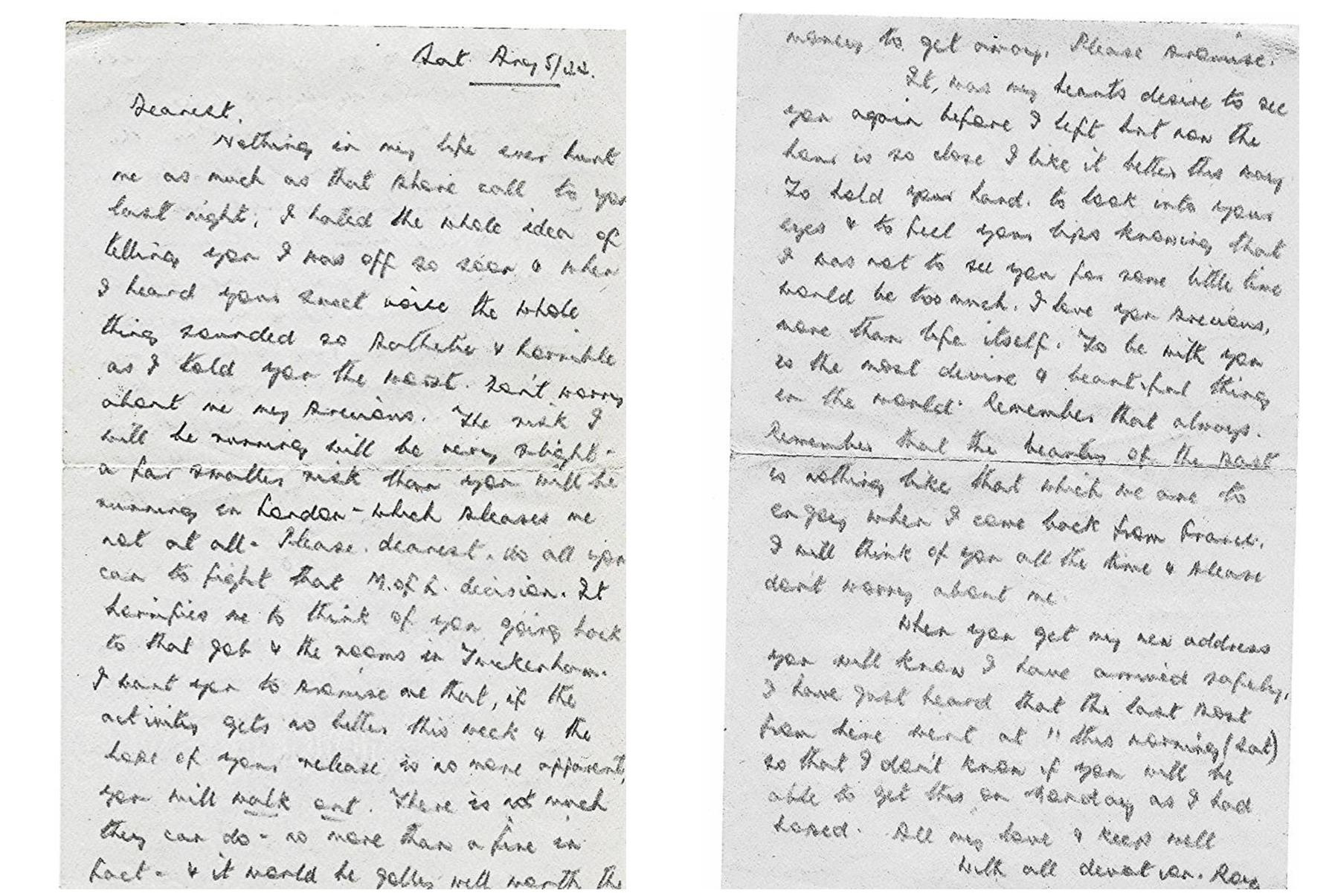
Nothing in my life ever hurt me as much as that phone call to you last night; I hated the whole idea of telling you I now off so soon & when I heard your sweet voice the whole thing sounded so pathetic & horrible as I told you the news. Don't worry about me my precious. The risk I will be running will be very slight – a far smaller risk than you will be running in London – which pleases me not at all. Please, dearest, do all you can to fight that M. of L. decision. It terrifies me to think of you going back to that job & the rooms in Twickenham. I want you to promise me that, if the activity gets no better this week & the hope of your release is no more apparent, you will walk out. There is not much they can do – no more than a fine in fact – & it would be jolly well worth the money to get away. Please promise.
It was my hearts desire to see you again before I left but now the hour is so close I like it better this way. To hold your hand, to look into your eyes & to feel your lips knowing that I was not to see you for some little time would be too much. I love you precious, more than life itself. To be with you is the most divine & beautiful thing in the world. Remember that always.
Remember that the beauty of the past is nothing like that which we are to enjoy when I come back from France. I will think of you all the time & please don't worry about me.
When you get my new address you will know I have arrived safely. I have just heard that the last post from here went at 11 this morning (Sat) so that I don't know if you will be able to get this on Monday as I had hoped. All my love & keep well.
With all devotion. Roy.
Letter 3:
Tues; Aug 8/44.
Dearest,
To find George almost on the door step waiting for me was to say the least astounding & un-believable. Osset, Huddersfield, London, France – could anything be more singular? For there he was this afternoon as large as life, as brown as a gypsy, a beam all over his face, crash helmet, motor bike & all! From two fields away. Just two fields! In the whole of this sector. He had arrived a week since after a three day journey by sea. He met the QM. who asked him to stay to tea, but having to get back quickly only stayed a few minutes with the promise of an hour to-gether tomorrow evening, when I have got things a bit more shipshape.
The trip over was both interesting & enjoyable. It was perfectly calm the whole time with glorious sun on the two days. Little did I realise when we so often watched those curious boats go out that I too would be lying on the roof of a lorry – for that was how it worked out – time, position & everything.
It was American manned with American food. We lunched on sweet corn (good old mealey – nothing near as good as that off the cob) creamed potatoes, diced carrots, creamed potatoes, fruit cream & coffee; sausages, beans, fruit & coffee for breakfast; spam, potatoes, fruit & coffee for tea, with white bread, real butter & jam at each meal. A whole days American menu did not leave me so impressed as it would sound to one reading it. For one thing it is too sappey & insipid – almost over treated. Couldn't use a knife & fork if you wanted too. There's just nothing to cut which leaves the jam & butter to spread the only use for the knife.
The boat was most comfortable. A mess, provided with a tin of milk & bowl of sugar at each table, held sixty at a sitting; hot water at all times is provided for a number of basins & showers (I had three as it was so hot) & bunks down the one side of the ship provided sleeping accommodation. The boat on the homeward journey takes German prisoners back. Four hundred went back on the trip before ours. The lower car deck is where they are put. We arrive safely without enemy activity looking brown & fit.
That, darling, takes us to the beaches & to-morrow I will tell you about France & the life we are living.
Take care of your precious self & pray as I do for a speedy re-union.
With all my love
Devotedly
Letter 4:
2356364
Wednesday
Dearest Love,
I’m afraid I have both good & bad news for you to-day. It would have not taken you more than a second to guess the bad. My name did not come out of to-day's hat for leave in April. What beastly luck, precious; I’m so terribly disappointed that I don’t know what to say. Lucky in love, down in a gamble – I had felt so sure that I would be going home to you in April & the thought of waiting another four weeks is just like a prison sentence. To-day's draw put's me in the bottom portion of the leave roster with 30 others who came over at the same time; but I can definitely promise you that without fail I will be on leave during the first fourteen days of May. This is most certain & you may bank on it with every penny you possess. I’m most frightfully sorry, darling, to have to tell you such bad news; but I hope the next bit will cheer you up a bit!
I’ve been specially mentioned & awarded a C-in-C's Certificate by Field Marshal Montgomery – the next best thing to a medal. It has to have been given me by the Commander himself but this could not be done. The Certificate reads as follows – it was given me to-day by the Colonel in front of the Regt:
W/Sgt Barton R.W.S. Royal Signals
It has been brought to my notice that you have performed outstanding good service, & shown great devotion to duty during the campaign in France.
I award you this certificate as a token of my appreciation, & I have given instructions that this shall be noted in your Record of Service.
B.L. Montgomery
20 Feb 45.
I don’t deserve this any more than the next man for all have performed outstanding good service & shown great devotion to duty since the first. It happens that my very position from the first, in charge of wireless stores, rations, & all other equipment has put me in a more outstanding position to be seen & felt in every way; every minute of the day. Some credit must go to my staff. They’re a good crowd – [unclear], the sanitary man with his disinfectant & privy veil; Sykes the boot & equipment repairer; Read with his wireless & line stores; English, clothing & Q Stores; & the cooks. A good crowd. Let me record here the cooks in person. [unclear], Officers mess, simple, with a lisp, but honest & from Sussex; Vickers, Sgts mess, from Birmingham & a partner in the firm of its leading caterers. Cpl Bygrave and Botts in the main cookhouse.
I love you so, much dear heart, & the thought of a further delay is not the least bit pleasant. Please take every care of yourself. I long more than ever to see you & our new home & to spend my days in your divine company.
With all my love
Letter 5:
2356364
Sgt Barton R.W.S.
Wednesday;
Dearest,
To be actually in the room where Rossini composed "William Tell" ought to inspire one to write something beautiful. Within these walls he lived & worked & so gained initial fame.
To-day a rather humble British soldier of World War II after a fourteen hour journey from the British sector writes to his wife in England. After eight months away with the liberating Armies he ought to be eager to start his three day leave in Paris. That is not truly the case.
As long as I live I hope I will never have to stay at a hotel without you. It depresses me. The whole atmosphere of a hotel without your sweet company leaves me more empty than outside these comfortable walls. The fact that some of Rossini's music grew on this spot only makes me want to cry out for you the more.
My very soul cries out for you beloved. My loss without you is beyond description. To be three days free in this gay capital means just nothing but a more agonizing loneliness, a more acute pain of utter sadness.
I love you so much, my darling, that a holiday without your sweet company is a holiday only in name. I will miss you so much these next three days – it will be worse as I have always so much wanted to show you Paris. On the long journey here you seemed so near me & now in this hotel I have lost you.
Whenever I hear "William Tell" I will always think of this sad moment as I write these lines, & my need for you. Only the nearness of our future comforts me – & that, beloved, is getting closer & closer. Our life is going to be so beautiful after the war – the anticipation almost takes my breath away. Each moment away from you is an age, each day a century. Never must I let you out of my sight when our life is renewed. I want to constantly feast my eyes on you, & hear for ever your voice, & feel your love around me.
For ever yours,
Photo caption:
Phantom Royal Corps of Signals Section Headquarters Dover Castle before D Day June 4