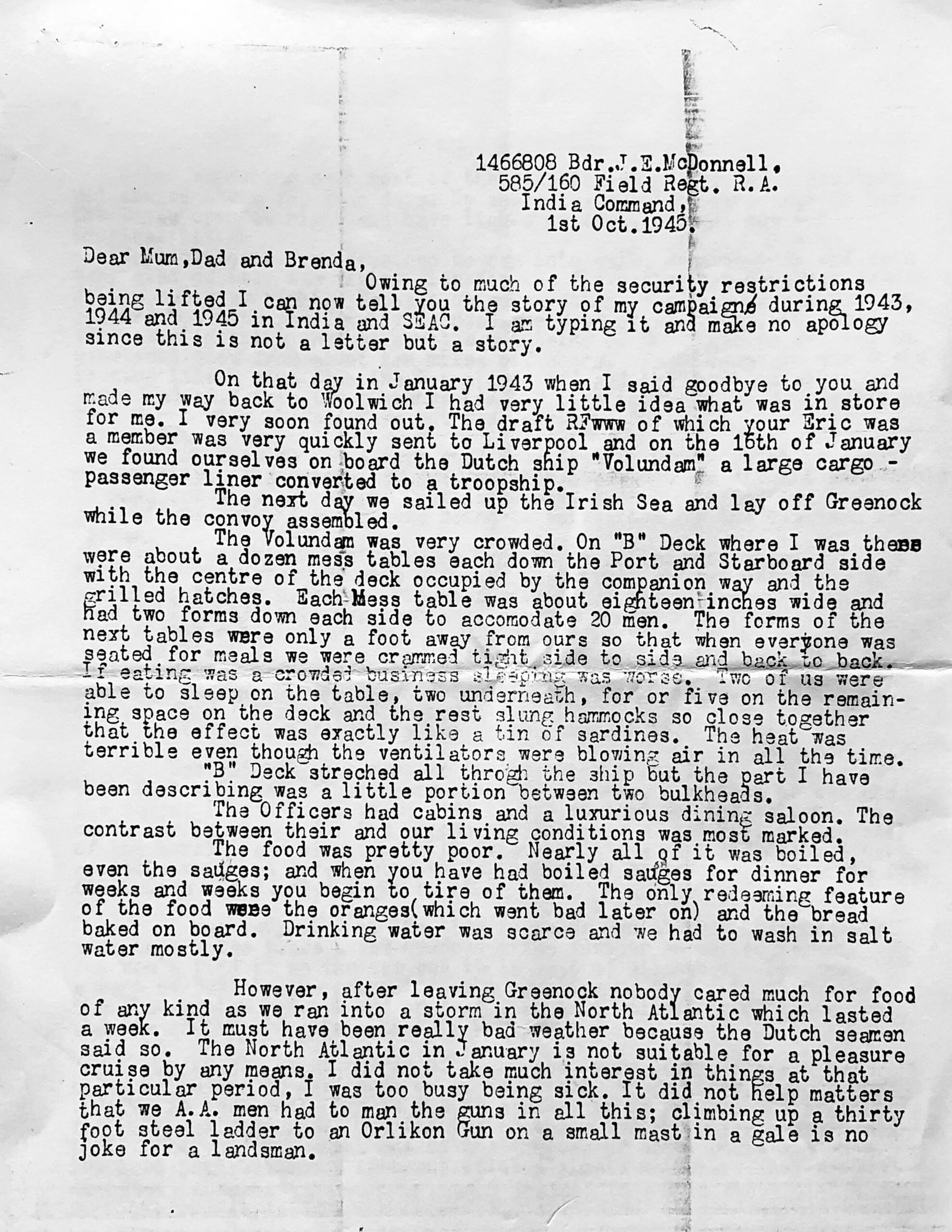
The letter is from my father to his parents sent from India at the conclusion of the war, detailing his service history since he left England in 1943, up until October 1945.
He was an anti aircraft gunner on the Indian-Burma border.
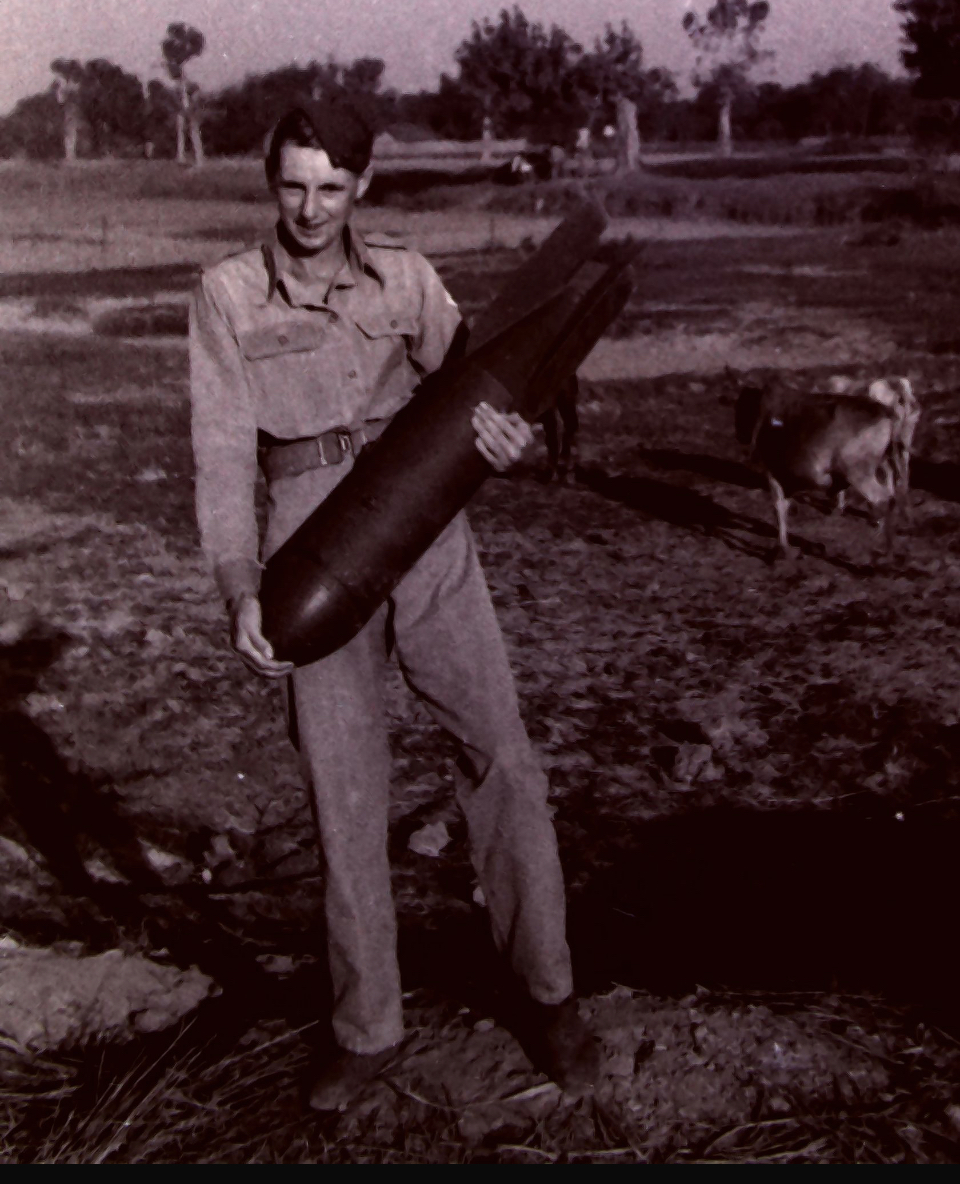
The photo below was taken at Karnafuli near Chittagong 1943, and shows Eric holding an unexploded Japanese bomb.
He died in 1981.
Transcript:
India Command
Dear Mum, Dad and Brenda,
Owing to much of the security restrictions being lifted I can now tell you the story of my campaign during 1943, 1944 and 1945 in India and SEAC [South East Asia Command]. I am tryping it and make no apology since this is not a letter but a story.
On that day in January 1943 when I said goodbye to you and made my way back to Woolwich I had very little idea of what was in store for me. I very soon found out. The draft RFwww of which your Eric was a member was very quickly sent to Liverpool and on the 15th January we found ourselves on board the Dutch ship "Volundam" a large cargo - passenger lines converted into a troopship.
The next day we sailed up the Irish Sea and lay off Greenock while the convoy assembled.
The Volundam was very crowded. On "B" deck where I was there were about a dozen mess tables each down the Port and Starboard side with the centre of the deck occupied by the companion way and the grilled hatches. Each Mess table was about eighteen inches wide and had two forms down each side to accomodate 20 men. The forms of the next tables were only a foot away from ours so that when everyone was seated for meals we were crammed tight side to side and back to back. If eating was a crowded business sleeping was worse. Two of us were able to sleep on the table, two underneath, for or five on the remaining spcae on the deck and the rest slung hammocks so close together that the effect was exactly like a tin of sardines. The heat was terrible even though the ventilators were blowing air in all the time.
"B" Deck streched all through the ship but the part I have been describing was a little portion between two bulkheads.
The Officers had cabins and a luxurious dining saloon. The contrast between their and our living conditions was most marked.
The food was pretty poor. Nearly all of it was boiled, even the sausages; and when you have had boiled sausages for dinner for weeks and weeks you begin to tire of them. The only redeeming feature of the food were the oranges (which went bad later on) and the bread baked on board. Drinking water was scarce and we had to wash in salt water mostly.
However, after leaving Greenock nobody cared much for food of any kind as we ran into a story in the North Atlantic which lasted a week. It must have been really bad weather because the Dutch seamen said so. The North Atlantic in January is not suitable for a pleasure cruise for any means. I did not take much interesting in things at that particular period, I was too busy being sick. It did not help matters that we A.A. men had to man the guns in all this; climbing up a thirty foot steel ladder to an Orlikon Gun on a small mast in a gale is no joke for a landsman.
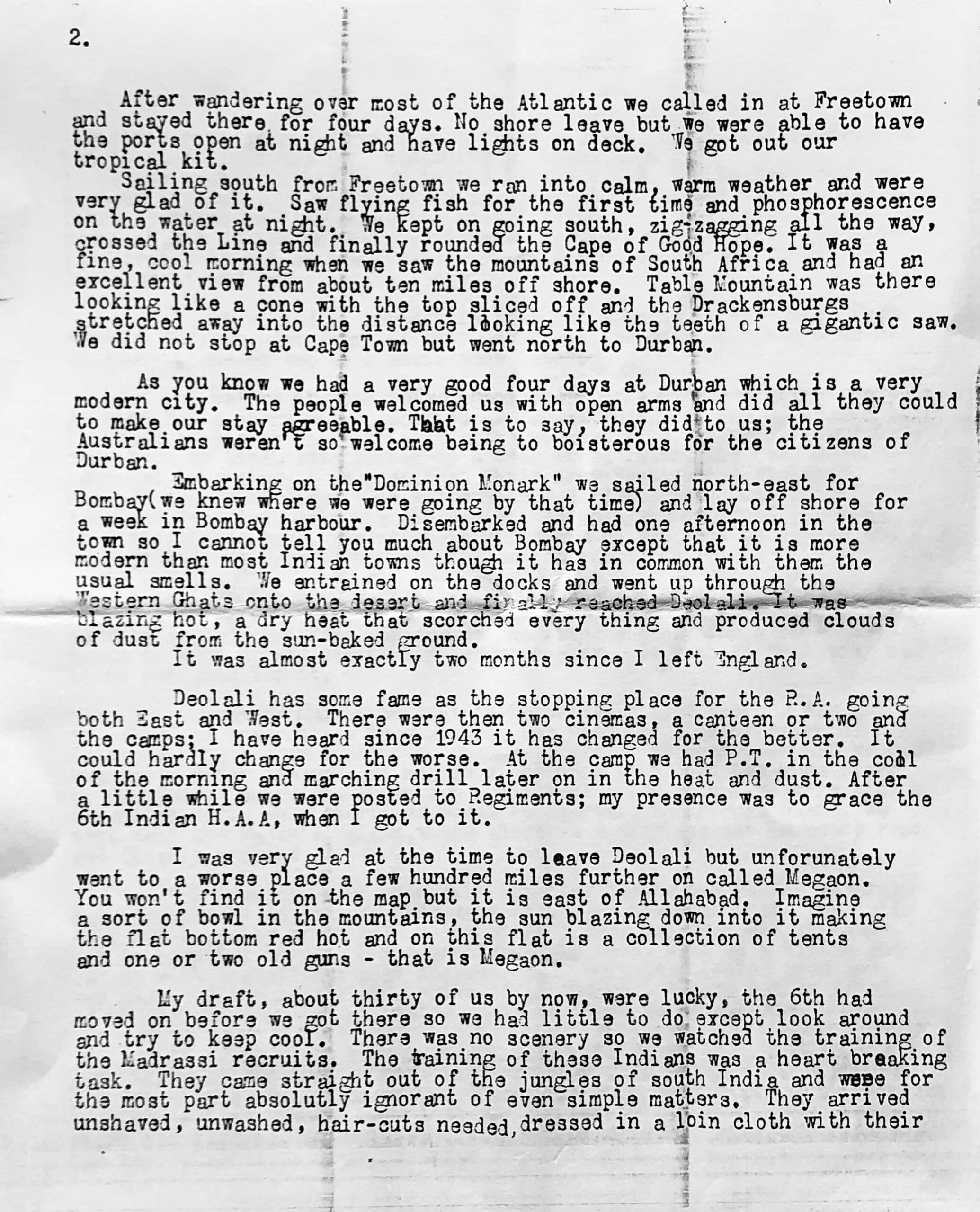
After wandering over most of the Atlantic we called in at Freetown and stayed there for four days, No shore leave but we were able to have the ports open at night and have lights on deck. We got out our tropical kit.
Sailing south from Freetown we ran into calm, warm weather and were very glad of it. Saw flying fish for the first time and phosphorescence on the water at night. We kept on going south, zig-zagging all the way, crossed the Line and finally rounded the Cape of Good Hope. It was a fine, cool morning and we saw the moutains of South Africa and had an excellent view from about ten miles off shore. Table Mountain was there looking like a cone with the top sliced off and the Drackensburgs stretched away into the distance looking like the teeth of a gigantic saw. We did not stop at Cape Town but went north to Durban.
As you know we had a very good four days at Durban which is a very modern city. The people welcomed us with open arms and did all they could to make our stay agreeable. That is to say, they did to us; the Australians weren't so welcome being to boisterous for the citizens of Durban.
Embarking on the "Dominion Monark" we sailed north-east for Bombay (we knew where we were going by that time) and lay off shore a week in Bombay harbour. Disembarked and had one afternoon in the town so I cannot tell you much about Bombay except that it is more modern than most Indian towns thought it has in common with them the usual smells. We entrained on the docks and went up through the Westens Ghats onto the desert and finally reached Deolali. It was blazing hot, a dry heat that scorched every thing and produced clouds of dust from the sun-baked ground.
It was almost exactly two months since I left England.
Deolalo has some fame as the stopping place for the R.A. going both East and West. There were then two cinemas, a canteen or two and the camps; I have heard since 1943 it has changed for the better. It could hardly change for the worse. At the camp we had P.T. in the cool of the morning and marching drill later on in the heat and dust. After a little while we were posted to Regiments; my presence was to grace the 6th Indian H.A.A. when I got to it.
I was very glad at the time to leave Deolali but unfortunately went to a worse place a few hundred miles further on called Megaon. You won't find it on the map but it is east of Allahabad. Imagine a sort of bowl in the mountains, the sun blazing down on it making the flat bottom red hot and on this flat is a collection of tents and one or two old guns - that is Megaon.
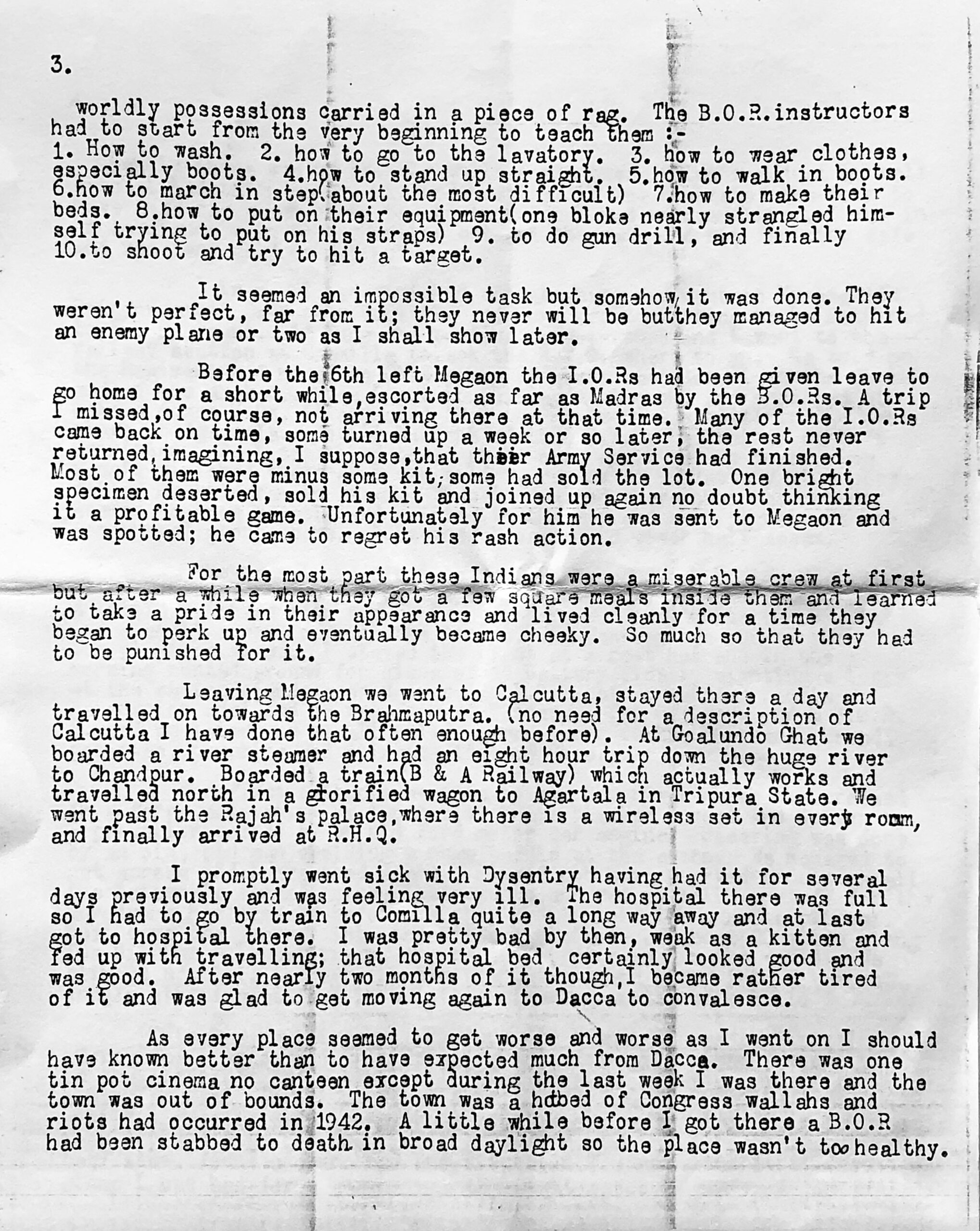
My draft, about thirty of us by now, were lucky, the 6th had moved on before we got there so we had little to do except look around and try to keep cool. There was no scenery so we watched the training of the Madrassi recruits. The training of these Indians was a heart breaking task. They came straight out of the jungles of south India and were for the most part absolutely ignorant of even simple matters. They arrived unshaved, unwashed, hair-cuts needed, dressed in a loin cloth with their worldly possessions carried in a piece of rag. The B.O.R. instructors has to start from the very beginning to teach them:-
1. How to wash. 2. How to go to the lavatory. 3. how to wear clothes, especially boots. 4 how to stand up straight. 5. how to walk in boots. 6. how to march in step (the most difficult). 7. how to make their beds. 8. how to put on their equipment (one bloke nearly strangled himself trying to put on his straps) 9. to do gun drill, and finally 10. to shoot and try to hit a target.
It seemed an impossible task but somehow it was done. They weren't perfect, far from it; they never will be but they managed to hit an enemy plane or two as I shall show later.
Before the 6th left Megaon the I.O.Rs had been given leave to go home for a short while, escoted as far as Madras by the B.O.Rs. A trip I missed of course, not arriving there at that time. Many of the I.O.R.s came back on time, some turned up a week or so later, the rest never returned, imagining I suppose that their Army Service had finished. Most of them were minus some kit some had sold the lot. One bright specimen deserted, sold his kit and joined up again no doubt thinking it a profitable game. Unfortunately for him he was sent to Megaon and was spotted; he came to regret his rash action.
For the most part these Indians were a miserable crew at first but after a while when they got a few square meals inside them and learned to take pride in their appearance and lived cleanly for a time they began to perk up and eventually became cheeky. So much so that they had to be punished for it.
Leaving Megaon we went to Calcutta, stayed there a day and travelled on towards the Brahmaputra (no need for a description of Calcutta I have done that often enough before). At Goalundo Ghat we boarded a river steamer and had an eight hour trip down the huge river to Chandput. Boarded a train (B and A Railway) which actually works and travelled north in a glorified wagon to Agartala in Tripura State. We went past the Rajah's palace where there is a wireless set in every room, and finally arrived at R.H.Q.
I promptly went sick with Dysentry having had it for several days previously and was feeling very ill. The hospital there was full so I had to go by train to Comilla quite a long way away and at last got to hospital there. I was pretty bad by then, weak as a kitten and fed up with travelling; that hospital bed certainly looked good and was good. After nearly two months of it though, I became rather tired of it and was glad to get moving again to Dacca to convalesce.
As every place seemed to get worse and worse as I went on I should have known better than to have expected much from Dacca. There was one tin pot cinema, no canteen except during the last week I was there and the town was out of bounds. The town was a hotbed of Congress wallahs and riots had occurred in 1942. A little while before I got there a B.O.R. had been stabbed to death in broad daylight so the place wasn't too healthy.
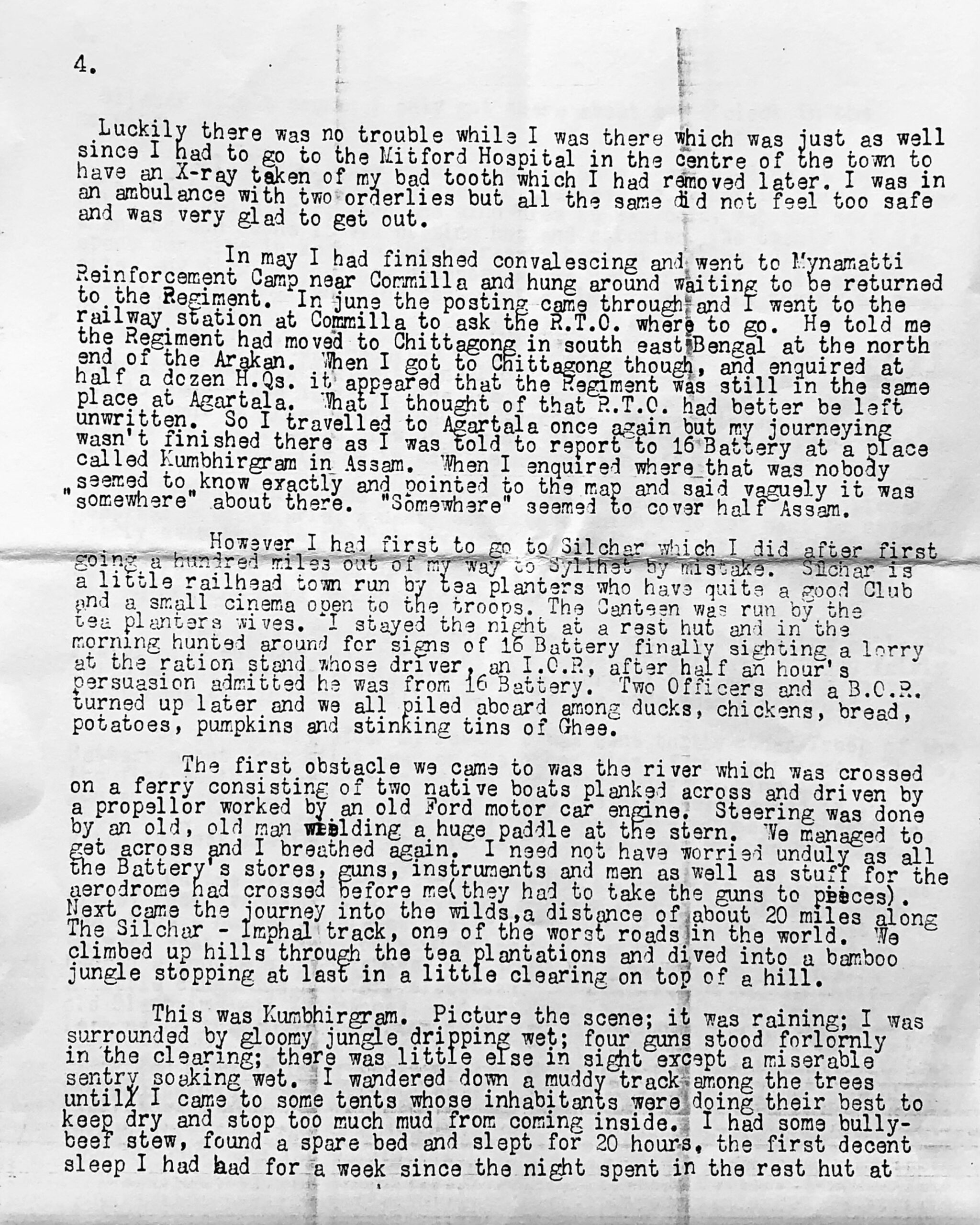
Luckily there was no trouble while I was there which was just as well since I had to go to the Mitford Hospital in the centre of the town have an X-ray taken of my bad tooth which I had removed later. I was in and ambulance with two orderlies but all the same did not feel too safe and was glad to get out.
In may I had finished convalescing and went to Mynamatti Reinforcement Camp near Commilla and hung around waiting to be returned to the Regiment. In june the posting came through and I went to the railway station at Commilla to ask the R.T.O. where to go. He told me the Regiment had moved to Chittagong in south east Bengal at the north end of the Arakan. When I got to Chittagong though, and enquired at half a dozen H.Q.s it appeared that the Regiment was still in the same place at Agartala. What I thought of that R.T.O. had better be left unwritten. So I travelled to Agatala once again but my journeying wasn't finished there as I was told to report to 16 Battery at a place called Kumbhirgram in Assam. When I enquired where that was nobody seemed to know exactly and pointed to the map and said vaguely it was "somewhere" about there. "Somewhere" seemed to cover half of Assam.
However I had first to go to Silchar which I did after first going a hundred miles out of my way to Syllhat by mistake. Silchar is a little railhead town run by tea planters who have quite a good Club and a small cinema open to the troops. The Canteen was run by the tea planters wives. I stayed the night at a rest hut and in the morning hunted round for signs of 16 Battery finally sighting a lorry at the ration stand whose driver, an I.O.R., after half an hour's persuasion admitted he was from 16 Battery. Two Officers and a B.O.R. turned up later and we all piled aboard among ducks, chickens, bread, potatoes, pumpkins and stinking tins of Ghee.
The first obstacle we came to was the river which was crossed on a ferry consisting of two native boats planked across and driven by a propellor worked by an old Ford motor car engine. Steering was done by an old, old man wielding a huge paddle at the stern. We managed to get across and I breathed again. I need not have worried unduly as all the Battery's stores, guns, instruments and men as well as stuff for the aerodrome had crossed before me (they had to take the guns to pieces). Next came the journey into the wilds, a distance of about 20 miles along The Silchar-Imphal track, one of the worst roads in the world. We climbed up hills through the tea plantations and dived into a bamboo jungle stopping at last in a little clearing on top of a hill.
This was Kumbhirgram. Picture the scene; it was raining; I was surrounded by gloomy jungle dripping wet; four guns stood forlornly in the clearing; there was little else in sight except a miserable sentry soaking wet. I wandered down a muddy track among the trees until I came to some tents whose inhabitants were doing their best to keep dry and stop too much mud from coming inside. I had some bull-beef stew, found a spare bed and slept for 20 hours, the first decent sleep I had had for a week since the night spent in the rest hut at Silchar didn't count; I only got there about two o'clock in the morning.
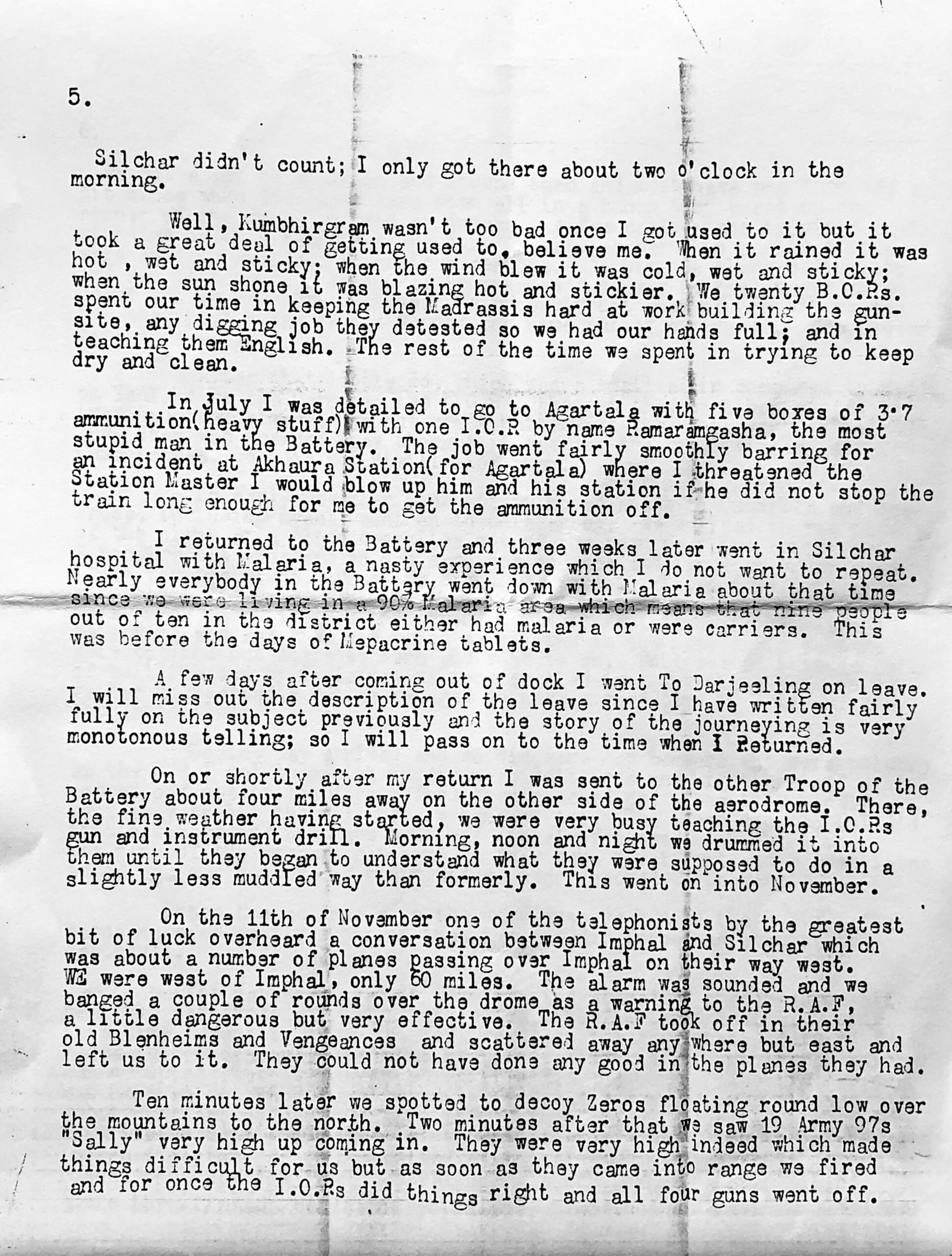
Well, Kumbhirgram wasn’t too bad once I got used to it but it took a great deal of getting used to, believe me. When it rained it was hot, wet and sticky; when the wind blew it was cold, wet and sticky; when the sun shone it was blazing hot and stickier.We twenty B.C.P.s spent our time in keeping the Madrassis hard at work building the gunsite, any digging job they detested so we had our hands full; and in teaching them English. The rest of the time we spent in trying to keep dry and clean.
In July I was detailed to go to Agartala with five boxes of 3.7 ammunition (heavy stuff) with one I.O.R. by name Ramaramgasha, the most stupid man in the Battery. The job went fairly smoothly barring for an incident at Akhaura Station (for Agartala) where I threatened the Station Master I would blow up him and his station if he did not stop the train long enough for me to get the ammunition off.
I returned to the Battery and three weeks later went in Silchar hospital with Malaria, a nasty experience which I do not want to repeat. Nearly everybody in the Battery went down with Malaria about that time since we were living in a 90% Malaria area which means that nine people out of ten in the district either had malaria or were carriers. This was before the days of Mepacrine tablets.
A few days after coming out of dock I went to Darjeeling on leave. I will miss out the description of the leave since I have written fairly fully on the subject previously and the story of the journeying is very monotonous telling; so I will pass on to the time when I returned.
On or shortly after my return I was sent to the other Troop of the Battery about four miles away on the other side of the aerodrome. There, the fine weather having started, we were very busy teaching the I.O.R.s gun and instrument drill. Morning, noon and night we drummed it into them until they began to understand what they were supposed to do in a slightly less muddled way than formerly. This went on into November.
On the 11th of November one of the telephonists by the greatest bit of luck overheard a conversation between Imphal and Silchar which was about a number of planes passing over Imphal on their way west. WE were west of Imphal, only 60 miles. The alarm was sounded and we banged a couple of rounds over the drome as a warning to the R.A.F, a little dangerous but very effective. The R.A.F. took off in their old Blenheims and Vengeances and scattered away anywhere but east and left us to it. They could not have done any good in the planes they had.
Ten minutes later we spotted to decoy Zeros floating round low over the moutains to the north. Two minutes after that we saw 19 Army 97s "Sally" very high up coming in. They were very high indeed which made things difficult for us but as soon as they came into range we fired and for once the I.O.Rs did things right and all four guns went off.
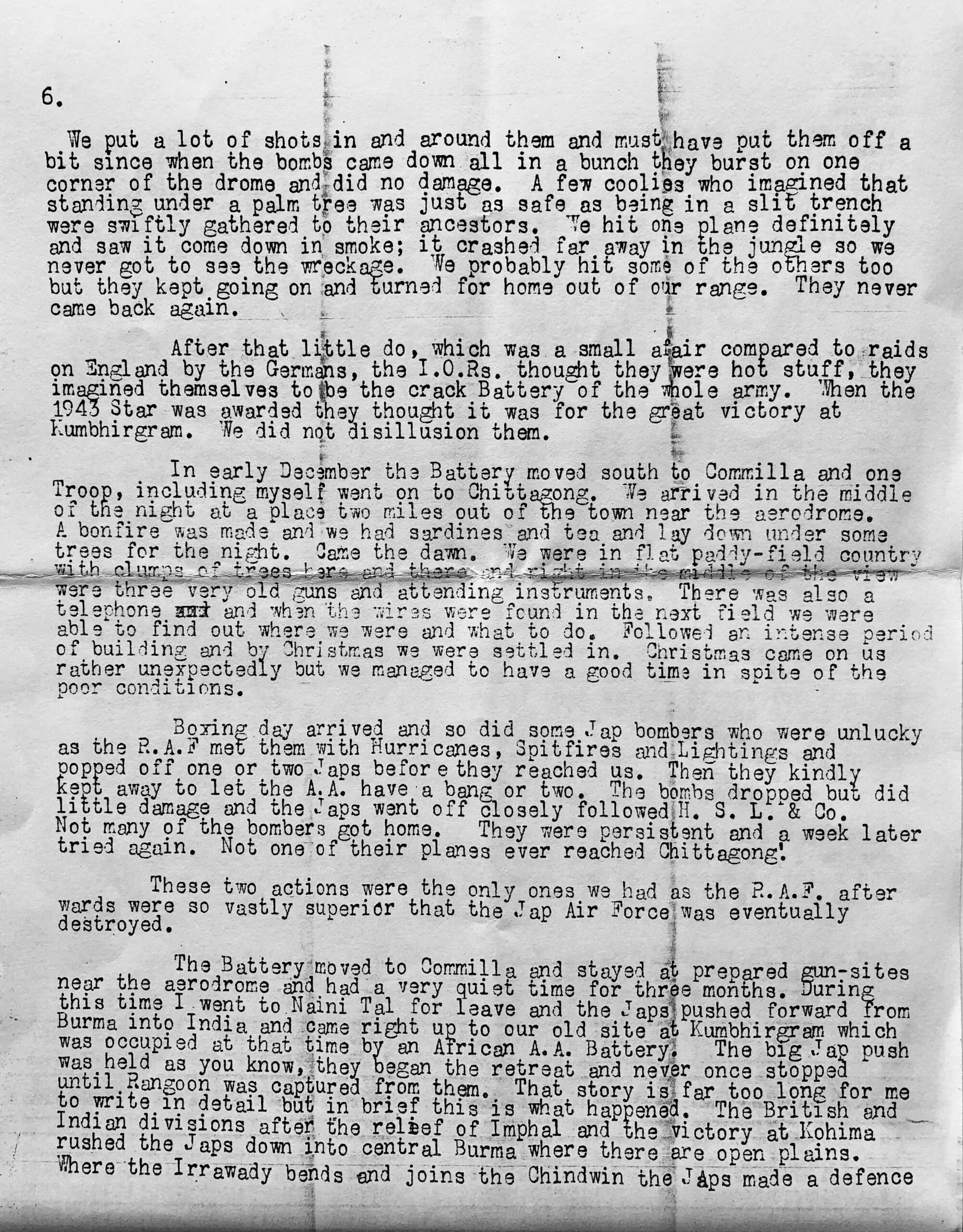
We put a lot of shots in and around them and must have put them off a bit since when the bombs came down all in a bunch they burst on one corner of the drome and did no damage. A few coolies who imagined that standing under a palm tree was just as safe as being in a slit trench were swiftly gathered to their ancestors. We hit one plane definitely and saw it come down in smoke; it crashed far away in the jungle so we never got to see the wreckage. We probably hit some of the others too but they kept going on and turned for home out of our range. They never came back again.
After that little do, which was a small affair compared to raids on England by the Germans, the I.O.Rs thought they were hot stuff, they imagined themselves to be the crack Battery of the whole army. When the 1943 Star was awarded they thought it was for the great victory at Kumbhirgram. We did not disillusion them.
In early December the Battery moved south to Commilla and one Troop, including myself went on to Chittagong. We arrived in the middle of the night at a place two miles out of the town near the aerodrome. A bonfire was made and we had sardines and tea and lay down under some trees for the night. Came the dawn. We were in a flat paddy-field country with clumps of trees here and there and right in the middle of the view were three very old guns and attending instruments. There was also a telephone and when the wires were found in the next field we were able to find out where we were and what do do. Followed an intense period of building and by Christmas we were settled in. Christmas came on us rather unexpectedly but we managed to have a good time in spite of the poor conditions.
Boxing day arrived and so did some Jap bombers who were unlucky as the R.A.F. met them with Hurricanes, Spitfires and Lightings and popped off one or two Japs before they reached us. Then they kindly kept away to let the A.A, have a bang or two. The bombs dropped but did little damage and the Japs went off closely followed H.S.L & Co. Not many of the bombers got home. They were persistent and a week later tried again. Not one of their planes ever reached Chittagong!
These two actions were the only ones we had as the R.A.F. afterwards were so vastly superior that the Jap Air Force was eventually destroyed.
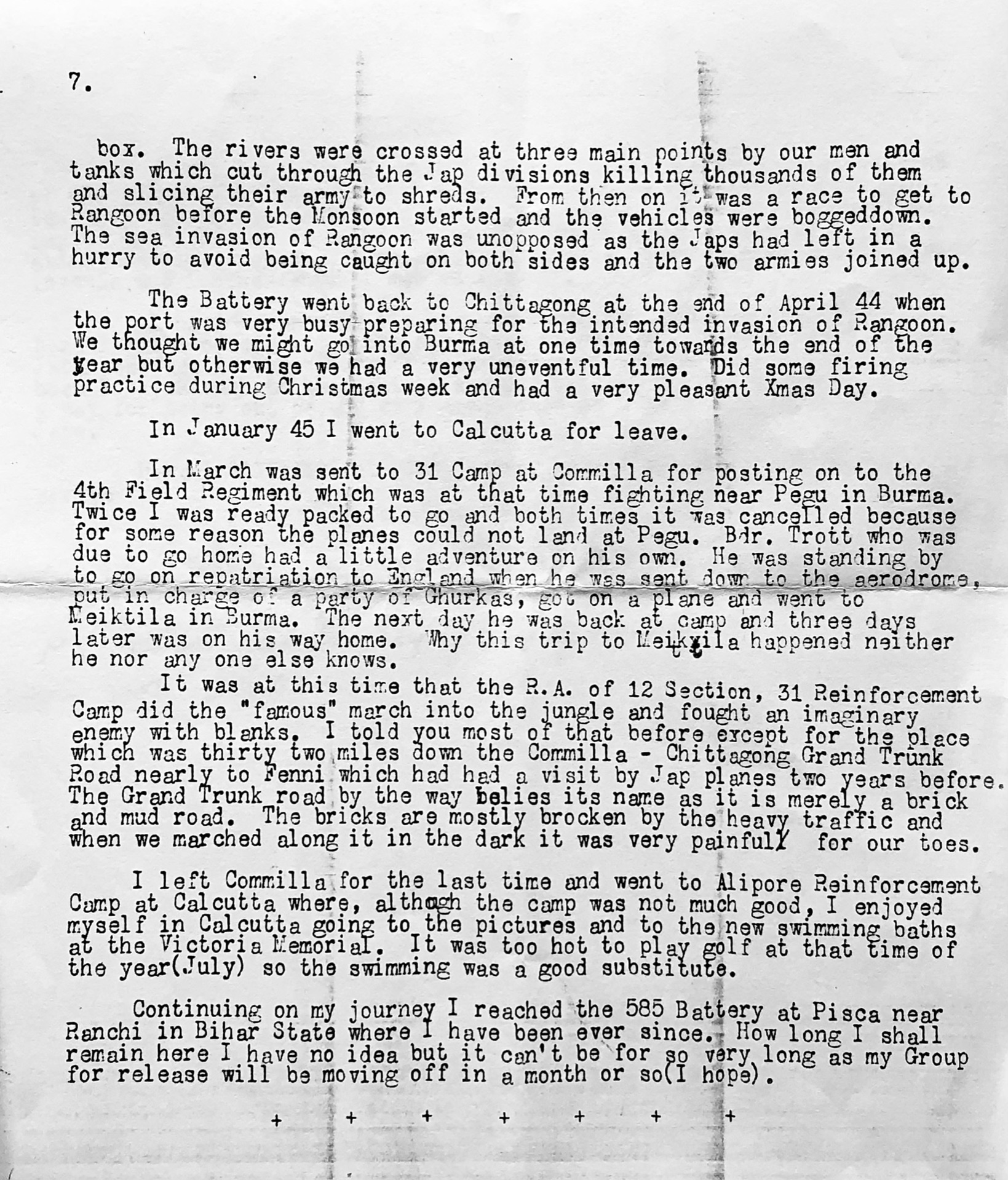
The Battery moved to Commilla and stayed at prepared gun-sites near the aerodrome and had a very quiet time for three months. During this time I went to Naini Tal for leave and the Japs pushed forward from Burma into India and came right up to our old site at Kumbhirgram which was occupied at that time by an African A.A. Battery. The big Jap push was held as you know, they began the retreat and never once stopped until Rangoon was captured from them. That story is far too long for me to write in detail but in brief this is what happened. The British and Indian divisions after the relief of Imphal and the victory at Kohima rushed the Japs down into central Burma where there are open plains. Where the Irrawady bends and joins the Chindwin the Japs made a defence box. The rivers were crossed at three main points by our men and tanks which cut through the Jap divsions killing thousands of them and slicing their army to shreds. From then on it was a race to get to Rangoon before the Monsoon started and the vehicles were bogged down. The sea invasion of Rangoon was unopposed as the Japs had left in a hurry to avoid being caught on both sides and the two armies joined up.
The Battery went back to Chittagong at the end of April 44 when the port was very busy preparing for the intended invasion of Rangoon. We thought we might go into Burma at one time towards the end of the year but otherwise we had a very uneventful time. Did some firing practice during Christmas week and had a very pleasant Xmas Day.
In January 45 I went to Calcutta for leave.
In March was sent to 31 Camp at Commilla for posting on to the 4th Field Regiment which was at that time fighting near Pegu in Burma. Twice I was ready packed to go and both times it was cancelled because for some reason the planes could not land at Pegu. Bdr. Trott who was due to go home had a little adventure on his own. He was standing by to go on repatriation to England when he was sent down to the aerodrome, put in charge of a party of Ghurkas, got on a plane and went to Meiktila in Burma. The next day he was back at camp and three days later he was on his way home. Why this trip to Meiktila happened neither he not any one else knows.
It was at this time that the R.A. of 12 section, 31 Reinforcement Camp did the "famous" march into the jungle and fought an imaginary enemy with blanks. I told you most of that before except for the place which was thirty two miles down the Commilla - Chittagong Grand Trunk Road nearly to Fenni which had had a visit by Jap planes two years before. The Grand Trunk road by the way belies its name as it is merely a brick and mud road. The bricks are mosly brocken by the heavy traffic and when we marched along it in the dark it was very painful for our toes.
I left Commilla for the last time and went to Alipore Reinforcement Camp at Calcutta where, although the camp was not much good, I enjoyed myself in Calcutta going to the pictures and to the new swimming baths at the Victoria Memorial. It was too hot to play golf at that time of the year (July) so the swimming was a good subsitute.
Continuing my journey I reached the 585 Battery at Pisca near Ranchi in Bihar State where I have been ever since. How long I shall remain here I have no idea but it can't be for so very long as my Group for release will be moving off in a month or so (I hope).
EPILOGUE.
Well there is is; what I have written is a very broad outline of the story of my travels with a few of the more interesting items to leaven a rather uneventful and monotonous account. I have not described any of the flora or fauna of the country which would simply be a list of palms, bamboos, mangoes, pineapples, elephants, tigers, wild boars, snakes, insects and leeches which I met on the way.
I have never actually been in Burma though I was near the border quite often and in the same type of country. I have never met a Japanese face to face though I have been near some several times. I have been lucky enough to keep out of serious trouble which compensates in a way for being out of any excitement such as a major action against the Japs.
Here I will finish. The journey home I will tell you when I arrive.
Yours affectionately
[handwritten] P.S. Please keep this safely I may want to read it myself when I get home. Eric.