The letter was left for me by my mother in a box of wartime memorabilia. It is a handwritten letter from my father, Donald Chapman, sent from his billet on 4th May 1945 when he received a secret message about the ending of hostilities. It was written to his mother (Bram) and sister (Rene), who were living in Stockport, Cheshire. It explains the excitement as his group heard the news. It is embroidered in red with the word ‘Victory’.
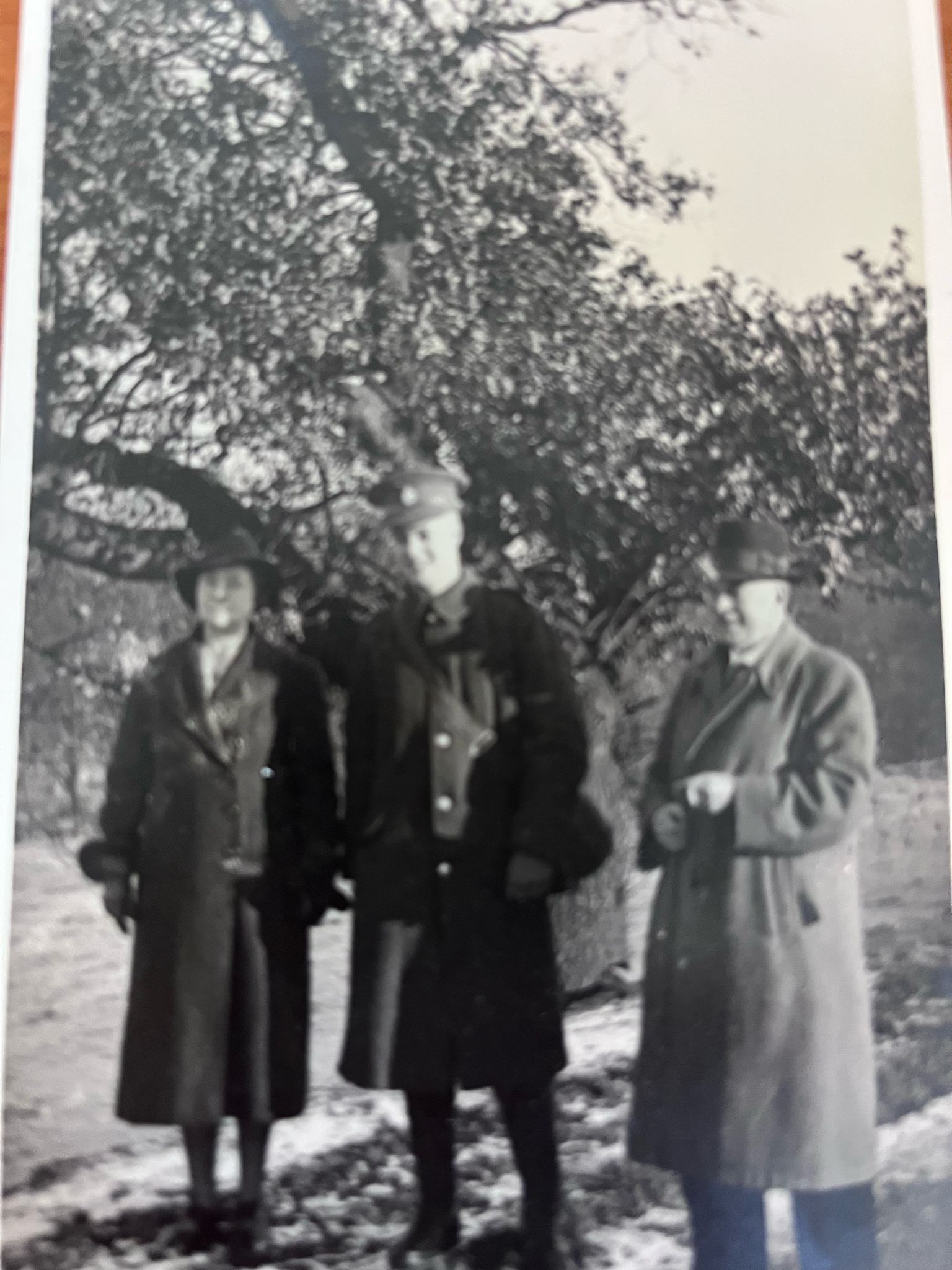
My father was a sensitive man who very much wanted to do his part, but would struggle to kill anyone. Somehow, he managed to join the medical corp which saw him on the front lines and also on the beaches of Dunkirk. The attached picture is of my father in uniform with his mother.
I also have his detailed memoirs, written as 20-year-old young man following his return from Dunkirk to the UK:
Transcript:
Letter:
VICTORY [embroidered in red]
7357040 L/Cpl Chapman RAMC
4. May. 45
Dear Bram, Rene,
I’ve just come in from a pleasant evening out, and as I entered the gate of this house, a messenger gave me a secret message, and shone a light as I read it. I was with my friend who read it with me, and – Ye Gods – I don’t know what happened next. – We chased each other round the garden, had a scrap on the stairs up to our billet, went into another bedroom, pulled three people out of bed, and generally got into a panic of excitement: The news was of the surrender of course, and in case you don’t known I ain’t fighting anyone no more; – no more guns; mines, or the other things which have scared the daylights out of me. – If this letter is written when I wake up in the morning, then I’ll know I’m not dreaming, but Bram, Rene, I can’t believe it, – I think I’ll go crackers if it’s really right, already my heart is pounding away at my ribs, and I feel too excited for words. – Fighting is I know going on down in the South, but that’s not my concern, – and if I don’t have to go to the far East, I’ll be coming home for good soon – it’s ridiculous isn’t it, – I’ve missed my home horribly for six years and now it looks as though I’m coming home to stay.
I’m not trying to write you a long letter, or even a coherent or sensible one, News doesn’t matter. – I’m going to bed now and if I wake up and find this letter isn’t written in the morning, then I’ll know I’ve been dreaming, but if this letter is still there, I’ll post it, so you can know just how glad I am to finish with war and that because with peace I can have my home back.
And now Goodnight, I’m too excited to sleep but so is everyone else, – I shall continue to take all care.
Isn’t it, – oh isn’t it beyond words, – Struth, I can hardly stand it.
All the love in the world,
Don
Memoirs:
[Cover page]:
DUNKIRK 1940.
Memories of the last days of service with the B.E.F. in Flanders.
Written by
21st November 1940.
[Page 1]:
It seems quite a long time since now, despite the fact that it is only seven months ago, that England lived through one of the most dramatic events in her long history, and now in the comparative safety of an English country home, my mind wanders back to those days which I can never forget, days which revealed only the best in a man. I remember that night on the Belgian frontier as if it were yesterday, when the Germans were beginning their invasion across Belgium towards us. Our feelings would not be hard to describe; they were feelings of delight at the prospect of what we could and would do, we knew full well the risks we should have to encounter, but who cared about risks? Our ambition was to show the French and Belgian people, how much we appreciated their kindness, and to show Adolph what war was like. In this spirit at 11 o'clock the following morning we boarded our vehicles. The engines were ticking over in an annoyingly slow fashion, but as the journey started we settled down, and soon were speeding on our way. After a couple of miles the lorry stopped, and we noticed the terrific convoy which was to go before and behind us, our unit of forty-two vehicles seemed to constitute a very small cog in a very big machine. After a brief pause the convoy started again, and we passed sand-bagged trenches, machine-gun nests, and barbed-wire fortifications. On and on we went, then, up went the red and white coloured pole before us, the frontier guard smiled, it was "Goodbye" to France, and "Hello" to Belgium. More defences, and now, open country with roads stretching for miles and miles, and at the end of those miles our object. "Why can't we go faster, why must we stop?" These are the words of every man as on and on we steadily and surely travel. At one point our drivers have their break for ten minutes, hardly have we stopped when a large scale air attack begins. The Belgian peasants pay no heed to their danger as they come to greet us, impressing us by their sincerity and cheerfulness. Beer, flowers, and souvenirs of all kinds are showered upon us, gifts from rich and poor old and young; everyone [...]
[Page 2]:
[...] wants to do something for us. To pay credit to these good people would be an impossibility – it is a task which I should never undertake – I think too much of them. After our break the journey continues, and each halt brings more examples of the people's goodness and generosity.
The night following this first stage of our journey, was spent in an old cowshed, from which we were all pleased to emerge thoroughly rested the next morning. After a breakfast of tinned bacon and biscuits the journey restarted, and for the next three days and nights, life continued as it had begun, riding eating and sleeping. One farm house we stayed at for one night sticks in my memory - How well I remember the lady who owned the farm; she was not fit to do hard work but she set an example to all of us, and her kindness was overwhelming. This lady reminded me very much of my own grandmother: a good reason for her being fixed in my memory.
Gradually the ferocity of the German air force increased, as gradually we came nearer to our objective; slowly the advance stopped, and our unit halted at a small village; here we were separated into three billets, each billet a farm house. Every billet we cleaned out and "made like home", our object being to enjoy a brief spell whilst waiting to halt the German advance - we waited two days then the awaited event started - I remember the pay parade which was being held, when the Germans were dive bombing a neighbouring Belgian town, and how quickly after the pay parade we packed up and went to meet the maniac who was driving towards us.
From this moment the world seemed to go mad. Everything happened at a speed practically inconceivable, no one could say whether we were advancing or retreating. There was a stream of refugees going both ways along the roads, some looking upon us with relief, some with despair, and others with faces totally lacking in any expression. These people had suffered terrible fates, they had suffered bombs, machine guns, shells, and worst of all, the knowledge that they were alone in the world, homeless, and without hope; their homes had been bombed and looted, and on [...]
[Page 3]:
[...] their long trek into France they were being mercilessly pursued by German airmen, who were inflicting horrible casualties amongst them to present an obstacle to our armies. I am proud to have served with my unit which is a Field Ambulance, and no doubt the word "Ambulance" will conjure up in anyone's minds the kinds of work we were honoured to be able to do. Our jobs were varied, but I feel sure that what we did was well done. - Two contrasts in my own work would serve as an illustration of the jobs we did:- one was to help into the world a baby, another was the assistance I could give to an old lady on her way out. The baby was born prematurely as a result of shock from a German machine-gunning attack,- the old lady died by the roadside in trying to rush for some safety - she was struck by a bullet, and further injured by a bolting wounded horse; she was alone, with no identification of any nature - just a victim of war.
Along the roadside we set up hospitals, and worked throughout the day and night, tending the wounded, and helping the weary to crawl to a vacant place on the ground, there to sleep whilst we attended to their blistered and bleeding feet.- Some of these refugees were real heroes.
In the meantime our army along with the Belgian and French stemmed the advance,- but slowly the Belgian resistance was weakening - the Belgian soldiers were leaving their posts and the French and British were left to bear the brunt,with the Germans coming round the flank vacated by the Belgians. Then the day arrived when the Belgian army surrendered - many Belgians fought on, - the news of surrender seemed ridiculous in the extreme. The first proof we had of this information was that of seeing a high Belgian officer strike down our Union Jack, and in it's place fly the white flag of surrender - It would be futile to describe the action we took, suffice it to say that within three minutes that white flag was helping in the work of our hospital by being used as a duster. After half an hour had elapsed we witnessed the most distressing military sight conceivable - our ex-allies the Belgian soldiers had finished their action - they were weary and demoralized [...]
[Page 4]:
[...] utterly defeated - the procession of soldiers seemed never ending - There was no order, no one seemed to be in charge. Some troops walked, some rode on horseback, some on bikes, and others packed themselves like sardines in ancient cars which had been picked up on the roadside, perhaps cars dumped as a result of the complete lack of petrol.
It was not more than a few minutes after watching this sight, when we received the final proof of the Belgium surrender. - This proof was the order to pack up and go. - No time was to be lost, in the words of the despatch-rider, "Jerry's half a kilo down the road, for God's sake, SHIFT"- . Shift we did, within eleven minutes our roadside hospital was closed, and everything and everyone was packed into the waiting lorries, when no time was lost in our rapid departure. We sped along those Belgian streets, not even knowing whether we were in neutral or enemy territory.- We didn't care either, all we knew was that the Belgians' surrender had increased our difficulties and danger - the bombardment was even more fierce, and the shelling more persistent. As we sped along we were well aware that the Germans had closed us in on one side, had reached the coast and were rapidly occupying new positions along the coast thus closing our communications with England. - We weren't concerned, the set-back. we thought, must have been insignificant really, and soon the positions our allies had lost would be retaken by the French and British - and with this confidence in ourselves we stopped not very far from France, and settled down for the night.
The German planes soon came over us when we stopped, but this time instead of bombs, we received leaflets. I remember well picking one up, and with a broad smile reading the contents printed on the paper. The leaflet was divided into three parts. The top part being a map showing the allied forces completely surrounded by the Germans - the centre part a message to the French reading "Frenchmen stop this needless resistance, surrender your arms, your generals have deserted, you are completely surrounded". - What drivel to expect us to read, we'd heard of Nazi [...]
[Page 5]:
[...] propaganda, but none so silly as this - how could we have been expected to believe such information to be true? - but it was. That night we settled down to sleep despite the thunder of our own artillery whi ch was firing from a field at the back of our billet. Next morning the order came to destroy everything possible, it was a ghastly sight to see the expensive equipment of our army being burnt, - but the destruction had to be. We lost almost everything, including all our own personal kit; all we kept was a small supply of essential equipment, such as bandages, splints, tourniquets, and morphia. We had to reduce our supplies in order to increase our speed and to reduce the number of our vehicles. Towards noon that day, we restarted our journey and made for the coast: it took us several days, and though it was only days, every minute seemed a day and every day a year. How well I remember that night huddled up in a ditch, or sheltering in a haystack, or sleeping in shippons, with wounded people on one side and cows on the other. - Conditions were deplorable but never once did anyone grumble - we were hungry and thirsty, but an order to live on the land soon cured this complaint. - How happy was I that day when I found a full tin of biscuits, a bottle of rum and a kit-bag full of tobacco on a dumped French army lorry, this heaven-sent load cheered us all up, and nothing from this improvised meal was left over. Someone else found a wireless set, and tuned it in to discover Jack Payne and his band, - we heard this programme, and then followed the news,- the announcer,- the same voice which we'd heard so many times before when sitting round our own fires at home in England in those days of peace, - told us of the safe evacuation to England from Dunkirk of many men of the B.E.F. - I don't remember exactly what happened after this to our wireless, But I remember Jerry aiming a supply of shrapnel into our midst, thus closing down our programme for the night. - This information however had cleared up one or two things in our minds, and we now knew that Jerry was not in Dunkirk - consequently we definitely had an opening to England. We did not know however that all the B.E.F. was to be evacuated, wishful thinking suggested to us [...]
[Page 6]:
[...] that we must go somewhere like England to be re-equipped - anyway we had too much work to do in tending the wounded to give time to our own thoughts, but that news bulletin did contain hope, and we wouldn't forget it.
Another day saw all our lorries destroyed - we just retained a few ambulances - these were showing signs of battle but that red cross on the vehicles meant a lot to many - after the lorries were destroyed we walked for miles, there was not a single moment for days on end when hostile aircraft were not over the top of us, and in walking we felt a certain degree of safety in being able to run for cover when the bombardment seemed imminent. - Our road was alongside a river in wide open country; we used to crowd under bridges over this river, and amuse ourselves with the sight of anyone getting too wet - after all what harm would a wetting do, didn't the Scots at the battle of Culloden, dip their plaids in water, and use the garment as a blanket ?.
In the distance smoke poured up, and stretched in thick clouds across the whole horizon, - the ship building yards could be seen, and flashes came from out at sea. - This spectacle was Dunkirk - our destination en route for England. We walked as fast as we could, while shells burst over and around us. Other shells went right over our heads, and crashed in the distance. - these latter shells were the voice of the navy. - the navy which had come to take us home to England. Next day after a hard walk we arrived at Dunkirk, a once happy seaside resort. Every building was shattered, not a sign of anything but soldiers anywhere. - on the beach was a shell torn ice-cream cart, and near it the remains of a German plane. Several German planes were shot down by the R.A.F, - if only the R.A.F. could have been with us all the time. - Their courage against terrific odds was magnificent, and never once did they fail to emerge from these dog fights victorious. Out to sea were several boats with just their masts sticking out of the water, but also further out was the Royal Navy, shelling the Germans continuously. - We waited on this beach for hours, and as night drew on, we gradually pushed along what once had been a promenade, and out along the jetty to embark on the boat [...]
[Page 7]:
[...] which was to take us home. Two boats were moored to the jetty, - the first one for some unknown reason I avoided, and thank God that I did, for this boat had only just put to sea when a shell burst in the middle of her. Fortunately most of her complement of soldiers and crew were rescued, but what a shock to those wearied soldiers to have to swim in a dangerous sea, waiting for help. Help of the highest order was given at all times, and in all places to these soldiers by their comrades in the navy. - I embarked on the second boat - an armed vessel of the merchant navy "The Royal Daffodil" this boat on her way out passed the wreckage of the boat which some time before had taken out our division from Southampton to Cherbourg "The Finela". Once on board the boat we tumbled down the gangway and donned life belts. - The relief was overwhelming, we were now the responsibility of the navy, - consequently in the very teeth of death we were safe. From this moment no-one seems to have known anything for some hours, - every one fell fast asleep. - Four hours later I awoke, and saw a light by the gangway. I remembered everything in a moment, and flew up the steps on to the deck. There I met a sailor and some Frenchmen - All I could see was sea everywhere, but inside me I knew the boats destination, and this knowledge the sailor confirmed. Shortly afterwards a mist grew in the distance, the mist became more and more solid, - slowly our naval escort fell behind, and the mist grew into the white cliffs of Dover. - I went almost mad with excitement, I rushed to tell my sleeping companions, who all immediately came on deck, and what a sight we must have presented, a group of wide eyed, speechless men surveyed the miracle. - Our feelings would never be described, they were beyond words. On we sailed and into Margate - We were home! people cheered and spoke our native tongue. On the spot we were recovered, every comfort was provided all along our seven hour journey, we all wrote home to say "we're home" Every man wanted to share the miracle, and tired though we were, we remembered the kindness of the people which we had passed, and the sacrifices made for us by those noble French and British soldiers on the other side who had got us out.
[Page 8]:
Their lives will have been shortened, but thousllllds thank God that they lived.
- - - . - -. - - 0 0 0 - - - - - -