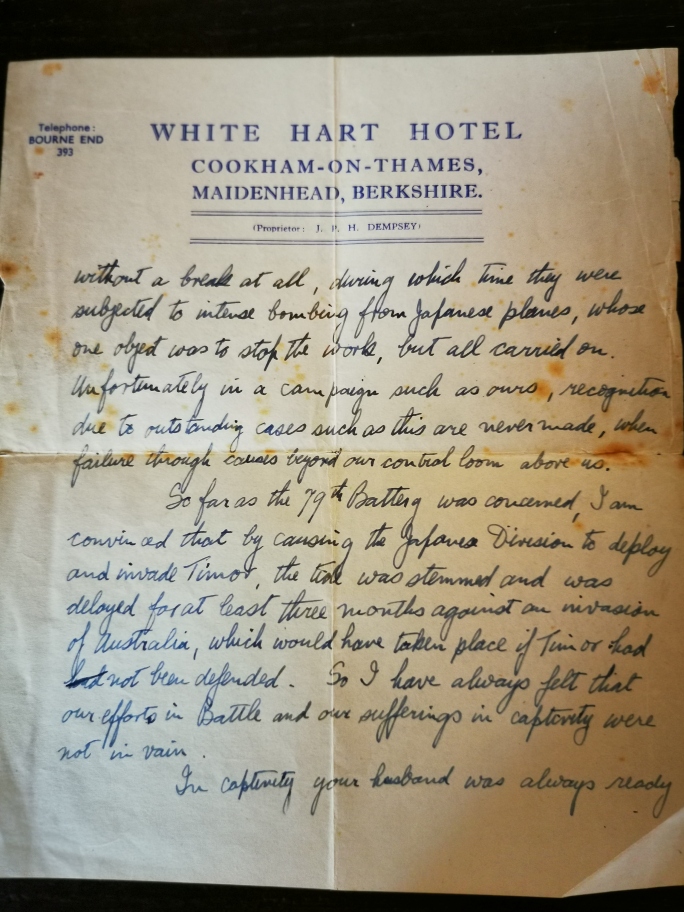
The letter was given to me – Harry’s grandson – following the death of my grandmother in 1989. It was part of the treasured memories of her husband along with Harry’s letter written on the eve of departure from Gourock in which he professed his love for her, promised he would remain out of harm’s way and would save his army pay to send back for the house keeping. She heard nothing more for nearly three years.
Major Dempsey was the commanding officer of Harry Lucas during the Battle of Timor in February 1942 and during three years imprisonment.
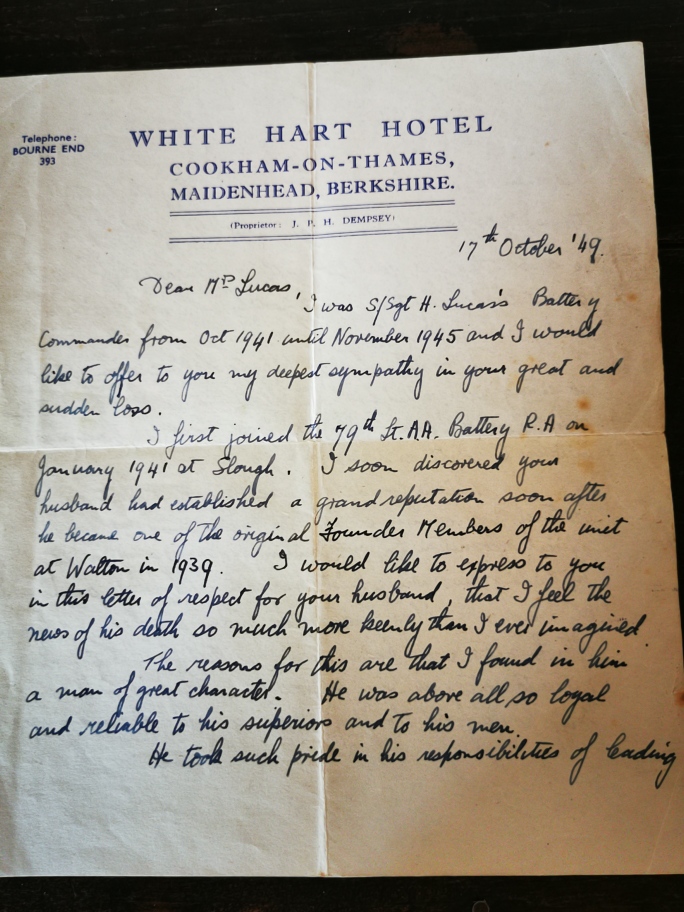
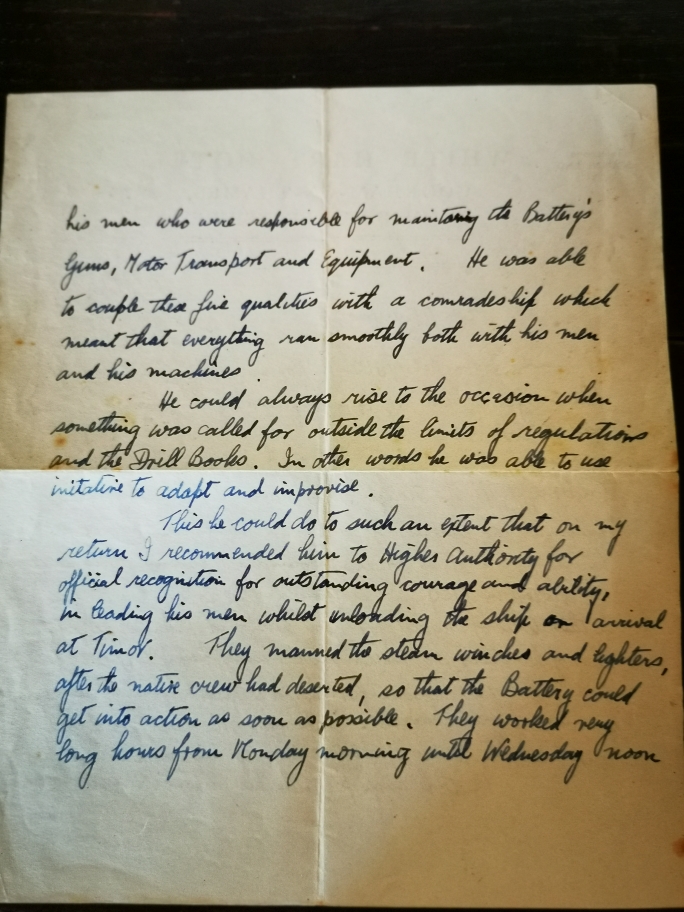
Major Dempsey’s handwritten letter which is still clearly legible, was written immediately after Harry’s death on October 15th 1949. He graphically describes Harry’s outstanding leadership under fire and motivation of the men responsible for the guns and motor transport of the unit fighting alongside their Australian comrades in the defence of the Timor aerodrome and subsequent retreat. He tells of their success in slowing down the Japanese advance on Australia and he writes of Harry’s character in maintaining morale with songs and football during three years of captivity and hard labour.
Harry was recommended by Dempsey for recognition of his bravery and exemplary service on Timor. In my research of the 79th’s deeds both in the Far East and during the Battle of Britain in defending key installations around London, including Prime Minister Churchill’s official country residence and the Hawker Hurricane factory at Langley, it is evident that both Luftwaffe and Japanese bombers suffered many losses from Harry’s guns.
On Timor the 79th served under the Australian Colonel Leggatt as part of the doomed Sparrow Force with whom they were also imprisoned after defeat, at Fukuoka near Nagasaki. Harry would have been entitled to wear the famous slouch hat and badge of the Australian army. He appeared as a witness at the Australian War crimes tribunal and his evidence helped see the Japanese camp commandant convicted and executed.
Transcript:
[Letter]
White Hart Hotel
17th October '49
Dear Mrs Lucas,
I was S/Sgt H Lucas's Battery Commander from Oct 1941 until November 1945 and I would like to offer to you my deepest sympathy in your great and sudden loss.
I first joined the 79th Lt, A.A. Battery R.A. on January 1941 at Slough. I soon discovered your husband had established a grand reputation soon after he became one of the original founder members of the unit at Walton in 1939. I would like to express to you in this letter of respect for your hisband, that I feel the news of his death so much more keenly than I ever imagined.
The reasons for this are that I found in him a man of great character. He was above all so loyal and reliable to his superiors and to his men.
He took such pride in his responsibilities of leading his men who were responsible for monitoring the Battery's Guns, Motor Transport and Equipment. He was able to couple these fine qualities with a comradeship which meant that everything ran smoothly both with his men and his machines.
He could always rise to the occasion when something was called for outside the limits of regulations and the Drill Books. In other words he was able to use initiative to adapt and improvise.
This he could do to such an extent that on my return I recommended him to Higher Authority for official recognition for outstanding courage and ability, in leading his men while unloading the ship on arrival at Timor. They manned the steam winches and lighters, after the native crew had deserted, so that the Battery could get into action, as soon as possible. They worked very long hours from Monday morning until Wednesday noon without a break at all, during which time they were subjected to intense bombing from Japanese planes, whose one object was to stop the work, but all carried on. Unfortunately in a campaign such as ours, recognition due to outstanding cases such as this are never made, when failure through causes beyond our control loom above us.
So far as the 79th Battery was concerned, I am convinced that by causing the Japanese Division to deploy and invade Timor, the tide was stemmed and was delayed for at least three months against an invasion of Australia, which would have taken place if Timor had not been defeated. So I have always felt that our efforts in Battle and our sufferings in captivity were not in vain.
In captivity your husband was always ready to uphold morale and self respect when others were rapidly becoming demoralised. When conditions were very hard and things looked blue he could always cheer our spirits up with his rendering of "McNamaras Band" - it was always a great tonic.
I had ample opportunity of assessing and judging character during those terrible days in Japanese hands.
I can only place on record that he was much more than just a founder member of the Battery, he was I know part of the backbone of the unit he loved - not just a member of the Royal Regiment of Artillery. I always have thought and always will think of him as such.
Yours sincerely
[Newspaper article]
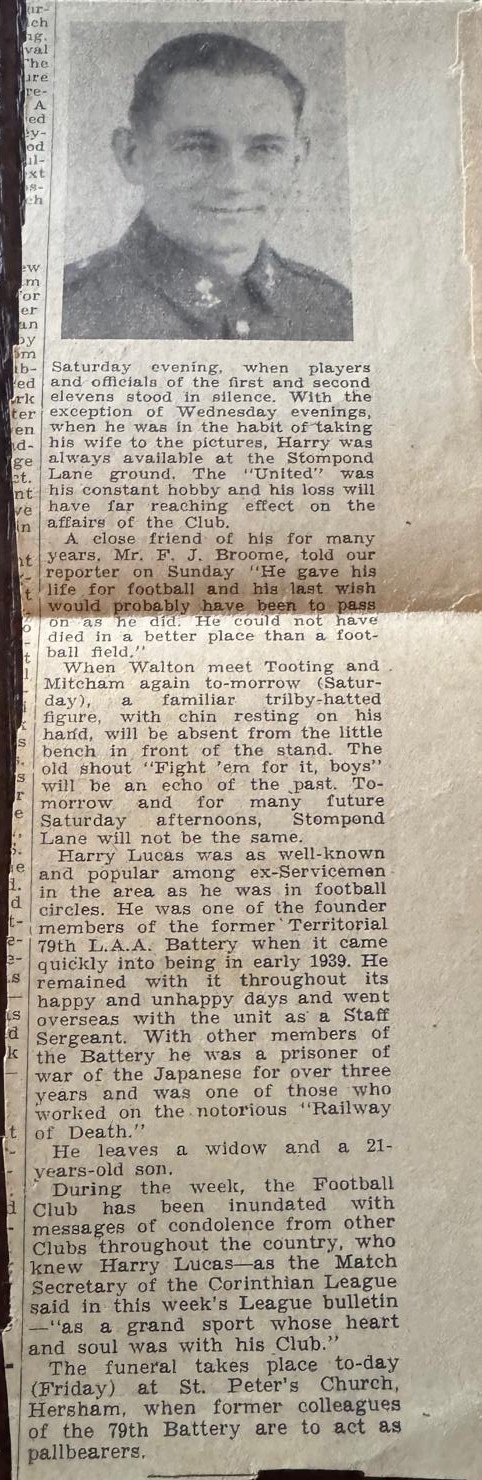
... Saturday evening, when players and officials of the first and second elevens stood in silence. With the exception of Wednesday evenings, when he was in the habit of taking his wife to the pictures, Harry was always available at the Stompond Lane ground. The "United" was his constant hobby and his loss will have far reaching effect on the affairs of the Club.
A close friend of his for many years, Mr F.J.Broome, told our reporter on Sunday "He gave his life for football and his last wish would probably have been to pass on as he did. He could not have died in a better place than a football field."
When Walton meet Tooting and Mitcham again to-morrow (Saturday), a familiar trilby-hatted figure, with chin resting on his hand, will be absent from the little bench in front of the stand. The old shout "Fight 'em for it, boys" will be an echo of the past. To-tomorrow and for many future Saturday afternoons, Stompond Lane will not be the same.
Harry Lucas was as well-known and popular among ex-Servicement in the area as he was in football circles. He was one of the founder members of the former Territorial 79th L.A.A. Battery when it came quickly into being in early 1939. He remained with it throughout its happy and unhappy days and went overseas with the unit as a Staff Sergeant. With other members of the Battery he was a prisoner of war of the Japanese for over three years and was one of those who worked on the notorious "Railway of Death".
He leaves a widow and a 21-years-old son.
During the week, the Football Club has been inundated with messages of condolence from other Clubs throughout the country, who knew Harry Lucas - as the Match Secretary of the Corinthian League said in this week's League bulletin - "as a grand sport whose heart and soul was with his Club."
The funeral takes place to-day (Friday) at St. Peter's Church Hersham, when former colleagues of the 79th Battery are to act as pallbearers.
[PDF article]
With the 80th anniversary commemorations of VJ Day nearly upon us I am completing a history of the outstanding war service of my grandfather Harry (born Henry) James Lucas - a staff sergeant in the Royal Artillery 79th Light Anti Aircraft Battery. After stalwart combat with their mobile befors guns defending reservoirs, airfields and aircraft factories during the Battle of Britain, the unit was despatched to the Far East to support Australian troops in the February 1942 defence of Timor as part of the "Sparrow Force". The heroic resistance of these troops, many from Western Australia, under Colonel Leggatt was credited with slowing the Japanese advance on the Great Southern Land and the service of the British and Australian comrades is well documented by Tony Paley in his 1991 book "The Sparrows" (IBBN 1-85421-145-5)
The force lost 82 soldiers with over 130 seriously injured and after surrendering in the face of insurmountable Japanese reinforcements, survivors of the 79th Battery were imprisoned first on Timor before transportation to Singapore, then loaded onto the infamous hellship Dai Nichi Maru and taken to work camps in Japan. Harry survived the battle and the journey which saw so many deaths at sea and was lodged injured in a camp near Fukuoka after being thrown off the deck at disembarkation.
When he died tragically early at 43 years of age, four years after the war, his Royal Artillery commanding officer Major James Dempsey wrote immediately to my grandmother with his condolences telling her how Harry's logistics abilities and leadership had ensured the successful unloading - whilst under bombardment - of the guns, tractors and ammunition which had been used in the bloody defence of the Pengfui aerodrome and subsequent retreat under fire. Major Dempsey wrote to "higher authority" recommending recognition of Harry's service in Timor and in his recollection of life in captivity also mentions how Harry's songs and love of organising football games between Allied prisoners had been vital in maintaining morale through the "dark days" of forced labour in coal mines and constructing airfield runways out of concrete girders around the city of Nagasaki. Harry, who was older than many of his comrades, must have seen much cruelty and death at the hands of the Japanese guards. There are records revealing that he testified at the War Crimes Tribunal held by the Australians which led to the execution of his camp commandant.
On his return to Walton-on-Thames, Harry walked back quietly into his kitchen to greet his wife and 18 year old son and then promptly left for his beloved Walton and Hersham football club. He took on mamangement of the team, purchased an open top Triumph sports car and led his players to four consecutive Corinithinian League championships before he was rewarded with an inscribed Smth's gold watch which I now hold and treasure. He died four years before my birth, from a heart attack on October 15th 1949 as the whistle blew and he stood to clap his men from the field. It was almost 10 years to the day since he had joined the 79th Anti Aircraft Battery.
A winner on the football field, against the Luftwaffe raiders, against Japanese dive bombers and overcoming the monstrous cruelties and torture of imprisonment, he won the hearts of his men and his superiors with his devotion to duty, sportsmanship and good humour. At his funeral, 400 attended including Sir Stanley Rous, the famous secretary of the Football Association and later FIFA.
On VJ Day my family will look again at our photos of Harry, clasp the gold watch and read again the words of Major Dempsey as well as the letter Harry wrote to my grandmother on the eve of his departure for the Far East in December 1941 in which he poured out his love for her and promised to save his service earnings and have them sent back to help with the housekeeping.
I will then continue to try and learn how Harry and his comrades survived on Timor and in the Kukuoka prison camp, as the Japanese Government's own records of those dark days have been flagged for release. I will also make contact with the Australian War Memorial and its historians to learn if their records show whether Harry ever received the famous army slouch hat and badge which was his entitlement as a soldier serving under Australian command.
The memory of his heroism, his sacrifice and that of his comrades will burn ever brightly.
Richard James Lucas